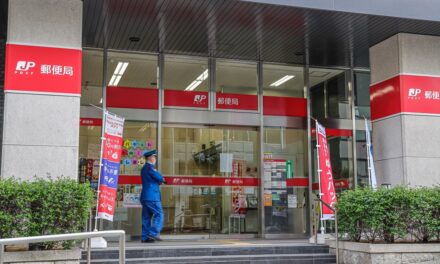



Japan Post sees international business as cornerstone
Japan Post aims to beef up its international business to survive intensifying global competition ahead of its planned privatisation beginning in 2007, according to Masaharu Ikuta, president of the government-owned entity.
"Our international business is small right now. But we are trying to establish the business as an important cornerstone in the future," Ikuta, the 69-year-old former chairman of shipping company Mitsui O.S.K. Lines Ltd. said.
Of Japan Post's 2 trillion yen in sales in postal services, 1.7 percent comes from the overseas parcel business. But Japan Post expects the global market to grow 1.9 times from the 4.9 trillion yen in 2002 to 9.2 trillion yen in 2012.
Notably, the delivery business within Asia is expected to grow 3.1 times in that period.
It has been a year since Japan Post was born as a public corporation after taking over the governmental Postal Services Agency's mail delivery, postal savings and "kampo" life insurance services.
According to a draft of the interim report compiled by the policy-setting Council on Economic and Fiscal Policy, headed by Prime Minister Junichiro Koizumi, the government panel aims to fully privatize Japan Post in 2017, following a 10-year transition period starting three years from now.
As a step to widen its overseas business, Ikuta said Japan Post is focusing on the rapidly growing Chinese market, and is currently negotiating to strengthen its ties with the Chinese postal authority.
He denied that China's State Postal Bureau had rejected — as was earlier reported — Japan Post's plan to set up bureaus in Beijing and Shanghai possibly next fall.
The talks are aimed at cutting costs and speeding up existing delivery services as well as developing new services between the two nations.
"As part of the economic cooperation between Japan and China, we are trying to promote mail and parcel delivery business with each other," Ikuta said, adding that negotiations are currently under way for approval to set up bureaus in Beijing and Shanghai by this fall.
The global market is currently dominated by four private carriers: Federal Express and United Parcel Service of the United States, DHL International of Belgium and TNT Post Group of Holland.
"We will consider the possibility of making an ally with global postal giants (in the future) to boost Japan Post's global competitiveness," Ikuta said.
When he became the president, Ikuta dispatched more than a dozen officials to overseas postal bureaus and financial institutions, including Germany's privatized Deutsche Post and the French state-owned La Poste for three to six months to learn from their experience.
In the area of domestic services, Japan Post during the past year has teamed up with private companies in various fields, including retail, transportation, banking, social services and entertainment, and offered new services.
For instance, Japan Post placed post boxes for regular mail in convenience stores operated by Lawson Inc., Circle K Japan Co., and Sunkus & Associates Inc.
It also formed partnerships with IY Bank and Sumitomo Mitsui Banking Corp., enabling postal savings customers to withdraw cash through the banks' ATM machines at Seven-Eleven Japan Co. and am/pm Japan Co. outlets.
"We need to create new postal services, since simply adding to or amending current services is not enough anymore," Ikuta said at a news conference last month.
Japan Post is also the country's biggest financial entity, with its postal savings and insurance policies standing at about 350 trillion yen. As a result, it has been criticized for hampering the private insurance and banking sectors.
Ikuta is opposed to separating the savings and insurance operations from the postal system after its privatization, and running its post office network solely by selling a variety of financial products, such as investment trusts. This idea, put forward by some experts, would not provide enough money, he said.
Fees from selling government bonds and providing settlement services stood at 80.4 billion yen for fiscal 2003, while it cost 4 trillion yen to maintain the nationwide post office network. Even if Japan Post boosts its lineup of financial products, the expected revenues would show an increase of only 300 billion yen at most, Ikuta said.
"It is true that the postal network is a precious treasury of the people," Ikuta said. "But it is also a fact that the revenues we can obtain from sales of financial products is too small to run the postal network."