


DHL reports on progress towards net zero by 2050
DHL Group continues its global decarbonisation journey with momentum. In 2025, the logistics company continued to advance several key levers of its sustainability strategy – from scaling sustainable aviation fuels (SAF) to electrification of the last mile and expanding solar-powered infrastructure.
These measures mark significant steps towards the company’s goal of net-zero greenhouse gas (GHG) emissions by 2050 and strengthen DHL Group’s role in building more sustainable, efficient and resilient global trade. Five milestones that have shaped this development:
Advancing sustainable air freight: Largest SAF agreement in the U.S.
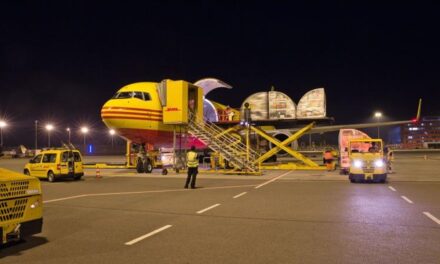
Air freight continues to be the most CO₂-intensive mode of transport per tonne-kilometre. DHL has been one of the pioneers in the use of SAF since 2021. In 2025, DHL entered into one of the company’s largest SAF agreements to date with Phillips 66: over 240,000 tonnes (around 314 million litres) of SAF over a three-year period. This reduces emissions by around 737,000 tonnes of CO₂e over the entire life cycle – about as much as 2,400 one-way flights from Los Angeles to Frankfurt. The fuel, produced in California, will primarily support DHL’s operations on the U.S. West Coast.
Hydrogen in focus: First pilot in the Middle East
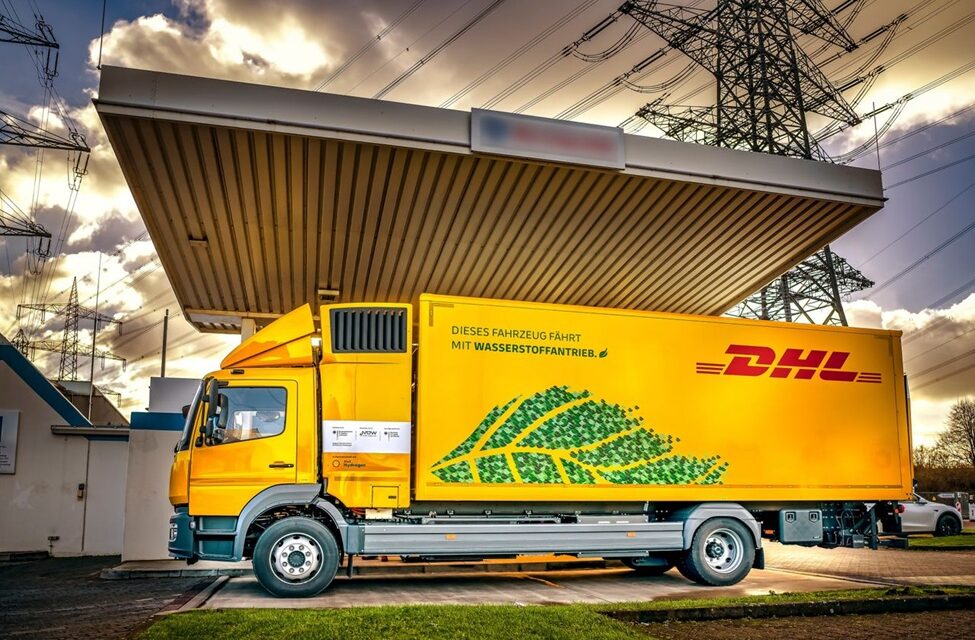
Hydrogen-powered trucks are emerging as a promising solution for decarbonizing long-haul transport, as they offer longer ranges than battery-electric vehicles. DHL is already actively testing hydrogen trucks in Europe, North America and Asia-Pacific and will now introduce them in the Middle East. Last year, DHL signed a Memorandum of Understanding (MoU) with Hyperview in Saudi Arabia to pilot hydrogen-powered trucks. The project supports Saudi Vision 2030 and includes a feasibility study on hydrogen infrastructure – further evidence of DHL’s commitment to reducing logistics-related greenhouse gas emissions in emerging markets.
Emission reduction at sea: partnership with CMA CGM
Since the majority of the world’s goods are transported by sea, sustainable marine fuel (SMF) is crucial for reducing emissions. DHL and CMA CGM, a French shipping and logistics company, have joined forces to acquire 8,800 tonnes of second-generation UCOME biofuel, enabling a reduction in CO₂e emissions of an estimated 25,000 tonnes (well-to-wake) – i.e. over the entire life cycle of the fuel. This is roughly equivalent to several days of operation of a large container ship. The partnership represents an important step towards low-carbon ocean logistics.
Fully electric delivery throughout Germany
DHL’s goal is to electrify around 66% of its last mile, the final step of delivering a shipment to the end customer, by 2030. Germany is playing a pioneering role in this. In 2025, the company announced its largest single order to date for electric commercial vehicles: 2,400 new electric vans from Ford for the Post & Parcel Germany division, most of which have already been delivered and are in operation. This means that around one third of all German postcode areas will benefit from delivery without greenhouse gas emissions in the future. Delivery will be made via a fleet of more than 35,000 electric vehicles, including e-trikes, e-vans and e-bikes.
Solar-powered warehouses in Asia
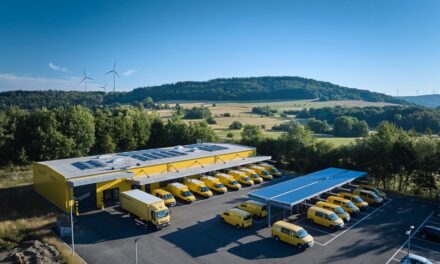
In addition to reducing operational emissions, DHL is increasingly investing in sites that generate their energy directly on site or from renewable sources – thus combining sustainability with energy autonomy. In Thailand, DHL opened a solar-powered warehouse last year. The plant is expected to generate 100% of its energy needs via a 4.2MWp solar system in combination with a modern battery storage system. This means that there is no longer any dependence on the fossil-based power grid – a groundbreaking model for future logistics infrastructures worldwide.