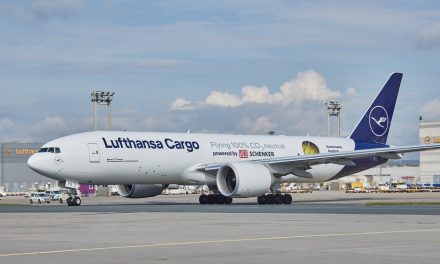



Interview with Jean-Peter Jansen, head of Lufthansa Cargo
What were the biggest problems that Lufthansa Cargo had to overcome last year?
The determining factor was the weakening of the world economy. The forecasts made at the start of last year had to be successively revised downward. If we look at Germany for example. the economy was initially projected to grow by’ 2.8%. In fact, growth rates soon fell to under 15 and in recent months the economy actually began to shrink. On one hand, this gives some idea of how radically the economic conditions have changed, and Ofl the other, it shows that the forecasts were not sensitive enough to pick up this development and give us sufficient early warning.
((The airfreight industry needs more effective forecasting tools. We believe that we have succeeded in developing them.))
Up to April last year, demand was still very strong. hut from that point on it collapsed in one market after the other. The downturn spread out from the Pacific to the USA. so that initially we were not too badly affected, hut then USA—Europe. Asia-Europe and vice versa were sucked in. Of course, we had to adapt to this rapid turnabout in economic fortunes.
4s airfreight carrier you are always to some degree on the receiving end. llhat can an airline do to prepare itself for unexpected falls in demand?
We have established that in many cases both our end customers in the manufacturing industry and our forwarders are just as adversely all ected as we are by wide fluctuations in the demand for transport services, like us. they must make long-term projections, which are also prey to a high degree of uncertainty, and they too are looking for the answer to the question: what is around the corner!
We really need a better forecasting system for the airfreight market. We started to work on this last year and have developed the Airfreight l)evelopment Index (ADX) (see box on page 26).This index is designed to give us an idea of how the airfreight market will develop from the next few months we do not believe that we can yet produce meaningful forecasts for a longer period. The ADX is a pioneering development, and there is nothing comparable available elsewhere in the airfreight industry. We saw that the correlation between the index and actual volumes was very high last year. Ve are particularly interested to see whether the recovery in the market predicted by the index in the third quarter of 2002 is actually realised. We are confident that the index will prove accurate.
Even with more accurate forecasts, I am confronted with increased volatility
in my business: I must respond to this volatility and set up corresponding structures. This is precisely what we did last year. Our production structures, in particular, have been re-designed to be more flexible. especially in terms of fixed costs (overheads).
Last year, our production shortfall in relation to targets was 10%. If our revenues can fall by this percentage, then our outlays must likewise he adjustable. This is not always easy, because usually costs are less flexible than revenues. However, last year we succeeded in adapting our cost structure, so that for example in the last quarter, after the events of last September. we were able to completely compensate for reduced revenues by corresponding reductions in expenditure. it is hard to achieve this one-to-one ratio in any industry, never mind in ours. By the same token, using this model, we will be able to get the full benefit from the economic upturn when it finally comes.
Do you also see the Capacity Purchase Agreements as a means of reducing volatility;’
This is a long-term project that is not directly connected with the management of volatility. We have been considering these agreements for a long time. In our opinion, there is an imbalance between the capital intensive services that we offer and demand. This is where a greater equilibrium is called for. In other industries it is common practice that, by entering a long-term agreement. customers can obtain more lavourable conditions than they would on a "one-off" or short term basis. In our indsutry there has been a tendency to allow customers to book capacity for the short to medium-term and to return it at short notice. That means that all the risk has been borne by those who have made the capital investment. We believe that this situation is unfair on those who are prepared to enter long-term commitments and gives last minute customers
too much leverage and disproportionate benefit from the capital assets. We have therefore set ourselves the goal of creating a compensatory system that is both logical and equitable from the perspective of capital commitment.
((Long-term commitment is a decisive factor in the supply chain"
Anyone who wants to reserve capacity for the long term must be prepared to actually take it, in return for a more favourable price structure. Customers who make reservations at short notice are not guaranteed access to capacity, or must be prepared to pay a surcharge or switch to an express product to ensure that their freight tonnage is shipped. As a consequence of their mutual interdependence, international production structures demand highly reliable delivery systems. If the delivery structures of an individual industrial customer are integrated in your production network, then the industrial customer needs assurance that his products will be shipped on time, irrespective of the general level of demand for airfreight capacity at the time. We are persuaded that in this case long-term integration — especially in the supply chain — is a decisive factor, a development which we are supporting through our approach.
What about small and medium-sized forwarders? Are they not disadvantaged because they are not in a position to enter a long-term agreement?
We do not think so. Among mediumsized firms, alliances and cooperatives are forming that enable their members to enjoy the price advantages that ensue from long-term commitments. It is doubtless the case that large firms will be able to benefit from these price systems more quickly. We plan to develop special solutions for smaller businesses.
Lufthansa Cargo has invested a lot
in information technology, electronic booking, online tracking & tracing and electronic air waybilis. What next?
We are examining reservations channels very closely: How much do they cost? What advantages do they bring? We have invested very heavily in new electronic reservations systems because we are convinced that they offer cost advantages to both parties. We and the forwarder are relieved from routine work, by for example the creation of channels for the sharing of data that does not require further analysis or processing.
(If a customer decides to use
a more expensive booking channel, it’s not our/oh to compensate him.))
If a customer decides to use a information channel that is significantly more expensive than the electronic alternative, then it is not up to us to compensate him for the additional expense. We believe that there is a clear rationale on both sides, because he would be acting
against his own interests, by incurring higher costs.
The fuel surcharge has disappeared from the agenda. Nonetheless, just before it was withdrawn, you modified the pricing methodology and refined the graduation of the surcharge levels. Do you have similar plans for the secuthy surcharge and are you already working on a tariff scheme for this surcharge?
In relation to the fuel surcharge, it is important that I mention that we have strictly kept to our commitments. A transparent outline of the surcharge is always available from our webpage. We have explained when and how the surcharge is to be levied and when it is to be withdrawn and that we are constantly reviewing and refining the methodology. We have changed the surcharge structure somewhat because we realised that there were some logical inconsistencies in the existing system. We are attempting to address such problems by reducing the thresholds between the individual increments, with the consequence that the surcharge now more closely reflects the real market value of kerosene.
In the case of the security surcharge, we do not levy it to make our balance look good, but because there have been changes in security requirements with cost implications whose full effects have yet to be felt and whose future
ment is difficult to forecast. Ihe issue of
insurance cover is still not resolved. In respect of security, certain points are still open and will remain in flux for some time. We are getting new directives from the various authorities all over the world on how to reshape our security structures practically by the day. Moreover, we are in a position of having to comply with a wide variety of requirements that vary from country to country. We are doing our best to encourage standardisation through Iata and the other airline forums.
Any further dramatic increase in the cost and complexity of security measures must be prevented. We hope that over the next few months a certain degree of stability on this front will return — this field too is characterised at present by a high degree of volatility — so that we can look to the future in a quiet and considered way.
CSC, which belongs to D.Logistics and takes care of Lufthansa's ground handling at Frankfurt, was forced to admit that there were security lapses in respect of personneL What is LH Cargo going to do in this case?
It appears that the pre-arranged, pre-defined procedures were not 100% complied with in all cases. We have taken immediate measures to prevent the recurrence of such incidents. We will raise the monitoring of the units to a yet higher lev
el — it is one thing to issue rules and another to ensure that they are observed — so that such lapses cannot be repeated, so far as is humanly possible!
What is the present security situation within Lufthansa Cargo itselfi
In this regard, I believe that we are in a good position. because our system has been continuously in operation and has remained intact over a long time. Since September 11 we have intensified our precautions. The system was already well structured in terms of security screening, access. etc.
We have decided to introduce additional security measures at Frankfurt to regulate our whole perimeter. The measures are designed to seal off the entire Lufthansa Cargo system as completely as possible. That has been decided, but I cannot give any more details. All I can say right now is that something is in the pipeline.
What will be Lufthansa’s priorities for this year?
One of them will definitely be the development of the New Global Cargo alliance. The alliance is proceeding well, but there is still more to be done concerning products and partners.
We will go on innovating special products and, on the sales and marketing side, we will continue to extend and heavily promote the electronic sales channels, such as
GF-X, the internet airfreight exchange (see article on page 25 on the right).
We are putting in place the structures that we will need to deal with the upturn so that we will be able to provide our customers with the capacity that they will then need.
How are things shaping up with capacity this year, and with the mothballed jumbo freighters?
We have two freighters mothballed at present. because it is impossible to generate extra demand by maintaining capacity. Nobody in industry would think of continuing to churn out goods if there was no demand, This is why we have mothballed — but not sold — this capacity, so that it can be made available as soon as it is needed.
Do you miss yang?
We regret that Varig quit the bilateral agreement, but on
the other hand we can understand that the decision was forced on them by econoniic circumstances. Varig’s
move has not however resulted in us downscaling our commitment to the South American market. We now control more or less the same market share alone that we previously shared with yang. We are now analysing the load factors and the market monthly so that we can make appropriate adjustments.
Has Lufthansa been picking up airfreight contracts from Switzerland following the problems with Swissair?
Yes, we have certainly gained some additional business. But change is to be expected when a market suddenly becomes insecure. It demonstrates how much importance forwarders and end customers attach to reliable and secure supply flows.
For small and mediumsized European passenger airlines, which market their own belly capacity. the only rational way forward is to
form large alliances. One model is afforded
by our cooperation with Spanair and Condor. We have integrated their capacity in our network and through contractual arrangements their airfreight volumes are now higher than those that they could have achieved by themselves. This means added value for everyone involved: We have a bigger network and can extend the reach of our innovative products while the partner airlines can concentrate on their core business of flying passengers. Moreover, we guarantee compatibility in the freight sector. A classic win-win situation, and one has to ask oneself why is this model not gaining more rapid acceptance? There are still far too many national barriers and political objections. but the trend will prove irresistible in the end. Airlines must weigh up this option carefully.
What are your hopes for Lufthansa this year?
Firstly, that the world economy indeed experiences the forecast revival. This would give everyone in the industry much needed encouragement. Otherwise, I believe that Lufthansa Cargo should consistently maintain its existing course. We have not changed the strategy for the last two to three years because we believe that it is the right one.