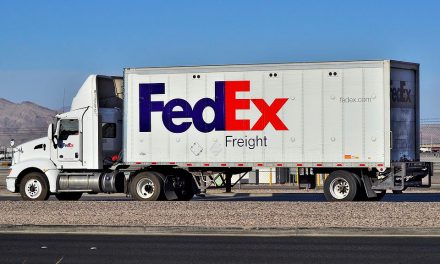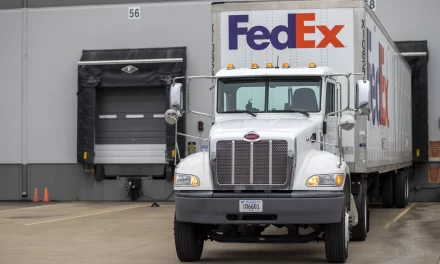




FedEx Freight CEO: gaining market share in ‘chunks’
FedEx Corp.'s (FDX) freight division continues to gain market share as more retailers and manufacturers go from talking about just-in-time shipping to actually doing it.
As those manufacturers move operations offshore, FedEx will gain even more of the domestic freight market as customers turn to FedEx for help with their international supply chains, said FedEx Freight Chief Executive Doug Duncan.
"More and more companies are actually executing fast-cycle logistics," rather than just talking about it, Duncan said in an interview with Dow Jones. "We strongly believe that we are taking market share in pretty big chunks."
In the fiscal third quarter ended in February, FedEx Freight's revenue rose 19% to $747 million, as its operating margin widened to 7.2% from 5.9% the year before.
FedEx's revenue growth is stronger than rival less-than-truckload carrier Arkansas Best Corp. (ABFS), which saw its fourth-quarter revenue rise 15%. Yellow Roadway Corp.'s (YELL) Yellow Transport unit's revenue rose 14.2% for the quarter. Less-than-truckload companies carry small freight shipments that don't fill entire trucks.
Fast-cycle logistics involves arranging deliveries of supplies or retail products just when they are needed. By doing so, companies lower the cost of holding and storing inventory.
As the U.S. economy recovered and more companies began shifting to fast-cycle logistics, less-than-truckload volume rose. That has boosted prices for less-than-truckload shipments and squeezed capacity, creating a boom for the shippers.
Some analysts say that boom is nearly over because carriers have added capacity and the retail economy appears to be cooling. But FedEx's Duncan says he will continue to gain market share as manufacturing moves offshore.
Here's why: for example, a factory in China makes blue jeans, and sends them to the U.S. on cargo ships. During the time it takes the ship to arrive at the U.S. port, some retail stores may be close to selling out of the jeans and need more right away, while others may still have plenty in stock.
So the FedEx customer can wait until the jeans are at the port to decide how many jeans each store will receive and how quickly. Some shipments may go by FedEx Freight, and some may need to go by air to arrive more quickly.
"We get far reach thanks to the international enterprise," Duncan said.
Duncan said he will continue to boost capacity, though he declined to say how much he plans to expand annually. He plans to build more facilities in the Sunbelt states, where the population is growing, and to expand in the Northeast, where FedEx Freight's presence is more sparse than in other parts of the country. He said he's "keeping an open mind" about acquiring other companies.
Duncan said he would like to buy a Mexican trucking company if Mexico changes a law that prevents foreign ownership of trucking companies.
Meanwhile, Duncan said he is working to integrate his sales force with the teams that sell other FedEx products. The freight and air transport sales forces have been integrated, and other products will follow. Part of the process involves integrating computer systems and updating customer profiles to consider which customers might like to add other FedEx products.
FedEx Freight also faces the same challenges its competitors face, including high fuel costs and traffic jams. Duncan said he's been successful at passing rising fuel costs along to customers through fuel surcharges, though he says he doesn't "take that for granted," as customers understandably tend to resist rate hikes.
Also, Duncan is scouting for ways to cut fuel-burn by finding ways to shorten routes and by using fuel-efficient technology.
Duncan said he is equally concerned that the high price of energy is hurting his customers' own operations, and could slow down production and, in turn, shipping volumes.
Duncan said traffic also concerns him. The Transportation Research Board, a division of the National Research Council, an independent government advisor, forecasts traffic will double by 2010, he said. Duncan is a member of the board's executive council.
So Duncan is stumping for the U.S. government to build more highways and to relax rules that slow down his trucks or hamper productivity.
-By Elizabeth Souder, Dow Jones Newswires; 201-938-4148; [email protected]
(END) Dow Jones Newswires