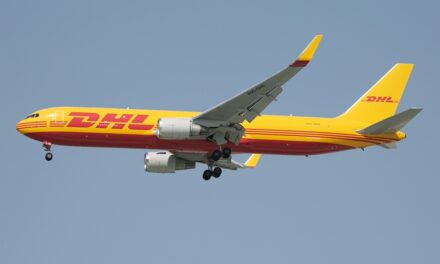




Renewed thrust for DHL: delivery firm says it has fixed infrastructure and will attack UPS-FedEx duopoly anew
The challenger came on strong last year with a splashy, $150 million ad blitz that portrayed its bright yellow fleet as a reliable alternative to UPS and FedEx.
DHL, long the dominant small-package carrier outside the United States, was determined to break into the domestic duopoly of UPS and FedEx which, together, control 80 percent of deliveries in the world's largest market.
It's been a bumpy road so far.
A series of breakdowns in DHL's domestic delivery network stranded huge numbers of U.S. packages last fall, lowered on-time deliveries to levels company officials called "totally unacceptable" and cost $280 million in lost revenue.
Now, with its infrastructure problems apparently fixed, DHL plans another major ad campaign during the Winter Olympics aimed at wresting market share from its American rivals.
"Our strategy going forward is totally unchanged, and it's beginning to bear fruit," said John Pearson, DHL's executive vice president. "We're challenging the duopoly here with a flexible, responsive and more human approach — and the reaction from customers has been very favorable."
Pearson said DHL's on-time performance in the United States during the hectic pre-Christmas season was about 97 percent, and that the company's $1.2 billion U.S. expansion is on track.
DHL officials have said they expect the company to be profitable here by the end of this year, but Pearson — who was in Atlanta for meetings with DHL managers — declined to make economic projections.
He said DHL intends to gain premium-priced international and next-morning shipments through the strength of its overseas brand and what it sees as its superior customer service. DHL said it won't drop prices in a short-term move to grab market share.
UPS and FedEx have responded to DHL's challenge by speeding up delivery times, increasing services and offering incentives to some large customers — moves that DHL must match to stay in the game.
Scott Davis, chief financial officer at Sandy Springs-based UPS, said DHL fundamentally misjudged the U.S. market, and that the European firm faces many years of major spending to build a domestic network that can match its competitors' speed, cost and reliability.
"They made a mistake," he said of DHL's first ad blitz. "They had a big ad campaign and didn't have the service capabilities to back it up. They've got a lot of work to do. Building infrastructure isn't something that takes one or two years. It takes one or two decades."
Satish Jindel, a transportation consultant, said growing demand among U.S. shippers is helping DHL recover. UPS and FedEx are focused on raising profit margins and won't launch price wars, he said.
"The transportation supply is so tight right now that there's no incentive for carriers to lower prices to gain market share," he said. "DHL doesn't have to be as big as UPS or FedEx in the United States to be profitable here. The company is very strong internationally, so it just has to have a legitimate presence here to leverage its international network."
DHL controls nearly 40 percent of international small-package shipments and has a commanding lead over UPS and FedEx in key European and Asian markets.
DHL moved forcefully into the United States in 2003 when it bought Airborne Express for $1 billion. UPS and FedEx mounted a string of legal challenges, saying the purchase violated U.S. laws against foreign airline ownership and accused DHL's corporate parent of using a foreign monopoly to subsidize its growth. But U.S. regulators eventually approved the deal.
Airborne had long been the discounter among U.S. delivery firms and focused on large, corporate clients with high-volume business. But DHL is pursuing a different retail strategy aimed at small shippers who pay premium prices.
"Airborne focused on business-to-business shipments, so they didn't need to be a household name," said Robert Dahl, analyst at the Air Cargo Management Group in Seattle. "DHL wants to raise service standards and compete with UPS and FedEx across the board. But DHL hasn't captured a substantially greater market share than Airborne — and its service standards have slipped. There hasn't been much shift in market share in the last two years."
DHL lost $650 million in North America in 2004 and was projected to lose more than $300 million in 2005, company officials have said. As a subsidiary of an overseas company, DHL doesn't release detailed financial or package volume data in the individual countries where it operates.
DHL's service problems in the United States came to a head in September and October when it closed its hub at the Cincinnati/Northern Kentucky International Airport and shifted package sorting to nearby Wilmington, Ohio. The switch was plagued by breakdowns, however, and on-time deliveries plummeted.
The service glitch was a blow to DHL, a subsidiary of Deutsche Post, the German postal service and a fierce UPS international rival.
For UPS, DHL's domestic challenge is a new front in a broader war. Both UPS and Deutsche Post aspire to be the world leader in logistics and supply-chain management — fast-growing fields propelled by global manufacturing trends. By designing and running corporate manufacturing, distribution and customer service operations, UPS and Deutsche Post expect to gain the strategic high ground and steer more traffic through their own delivery networks.
UPS and FedEx lost huge sums internationally in the late 1980s and early 1990s as they launched or expanded small-package delivery networks overseas. But Pearson said DHL is determined to become a significant player in the United States and won't be in the red here for long.
"There's no suggestion of backtracking on our investment plans," he said. "Our strategy is working — and we're here to stay."