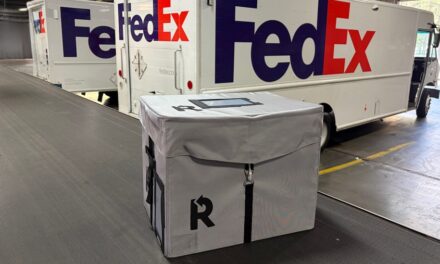




FedEx launches separate home delivery business
Responding to burgeoning de-mand for residential deliveries, a Federal Express operating company has launched a new service aimed directly at that market. FedEx Ground, formerly RPS, began oper-ating its FedEx Home Delivery ser-vice in 38 metropolitan areas in mid-March. The company says that at startup, the new service can reach about half the population of the United States. FedEx Home Deliv-ery’s plans call for rapid expansion, with a goal of reaching the entire U.S. population in four years.
FedEx expects demand for ground delivery services to resi-dences to soar. The company cites a forecast by the National Research Federation that the home delivery market will more than double by 2003. Much of that will be driven by the growth in Internet retail sales, which Forrester Research ex-pects to reach $184 billion by 2004, up from $38 billion this year.
The new service offers the indus-try’s first money-back guarantee for residential ground deliveries. FedEx Ground’s existing infrastructure provides the pickup and the line-haul, but FedEx employs a separate system, with separate terminals and a corps of more than 400 driver/contractors, to handle deliv-eries. The whole system is separate from FedEx Express, the company’s express transportation service.
Daniel J. Sullivan, president and chief executive officer of FedEx Ground, cites several reasons for es-tablishing a separate home delivery network. A system that is specifi-cally focused on home delivery helps to differentiate the service from those of competitors. In addition, some of the technology that was needed for the home delivery service
was not compatible with the tech-nology that was already in place for the business-to-business network. Furthermore, FedEx did not have sufficient capacity in any of the 38 initial markets to handle the addi-tional volumes he expects the home delivery service to generate. Finally, he says, he wanted to install a man-agement team that was dedicated to home delivery, ensuring that the business did not take a back seat to other FedEx Ground business.
Shippers that use the service will transmit package data via electronic data interchange to FedEx Home De-livery. The company uses that infor-mation to create delivery instructions for individual shipments. The carrier then uses the accumulated data to de-velop vehicle load plans, optimise routes, and generate maps and dri-ving instructions for the drivers.
Sullivan says base rates for the FedEx Home Delivery service are similar to FedEx Ground rates. In addition, the company offers a num-ber of premium services, including Saturday, evening, and appointment deliveries. Service rates are negoti-ated with each shipper.
Sullivan notes that because dis-patch begins later in the morning, drivers are staying in the neighbourhoods until 8:00 or 8:30 p.m. The normal workweek for drivers will be Tuesday through Saturday to better accommodate consumer demands.
The company expects to spend $100 million to $125 million to build the home delivery network over three years and expects to gen-erate operating losses of $50 million to $60 million before breaking even in its third year.