



Possible privatistion of Amsterdams Schiphol Airport
Schiphol is already the fourth largest gateway in Europe for both passengers and cargo. The recognition that this fact provides will be further boosted over the next few months, thanks to the part-privatisation of parent company Schiphol Group (see panel page 6). Meanwhile, the airport is pursuing various initiatives and projects which should ensure its continued development as more than a mere air transport hub. Beyond 2010, though, the future is not yet clear.
The Schiphol Group makes much of its “AirportCity” concept, which basically involves developing the airport as a centre for a wide range of international business and leisure activities. “You could call Schiphol the Netherlands’ newest city because in addition to runways, it has all the other things that make a city appealing and alive,” claims Schiphol Group chairman Gerlach Cerfontaine. For example, shops, restaurants,
multimedia facilities, banks, hotels, chi!dren’s play areas, an Internet bar, a casino, office space, meeting facilities and “sufficient open and green space to make the entire environment pleasant and liveable”. There are also frequent bus and train services, sufficient taxis, good motorway connections and ample parking facilities to make it easy for people and cargo to move in and out of this city”.
Those features, together with the proximity of the huge Rotterdam port, have already helped Schiphol to develop as one of The Netherlands’ most important economic engines. Nearly 55,000 people now work on the airport, and another 50,000 nearby, for approximately 550 organisations, including airlines, international company headquarters, European Distribution Centres (EDCs), Information a nd Communication Technology (ICT) companies and call centres. Schip
hol says that 50% of all US and Japanese companies have located their European HQ and/or EDC in the Netherlands, often close to the airport.
CARGOWORLD
The AirportCity strategy is reflected in the development of CargoWorld Schiphol, where “the freight process is combined with the most modern facilities”. In practice, that means integrating aircraft operations with customs facilities, handling/distribution warehouses and hinterland road/rail connections in a bid to provide customers with a wide range of added-value services and the most efficient overall logistics package. The formula helped Schiphol double its cargo volume during the last decade.
Three years ago, Schiphol boosted its commitment to the CargoWorld concept by sponsoring a project called Efficient Cargo
Communication (ECC). Basically, that involves all the air cargo companies at the airport collaborating to reduce waiting times for collections and deliveries, customs clearance and so on. “In addition to international initiatives such as Cargo 2000, we found that we can also take local initiatives to facilitate movements,’ says Schiphol cargo director Gert-Jan Hermelink.
Slot times have been introduced at warehouses for truck drops or pick-ups, and this process will be further enhanced by development of an Internet software program to provide electronic pre-alerts between handling companies and forwarders.
The percentage of export customs declarations was raised from 20% to 90%, and the local Hoofddorp Customs district organisation is currently exploring ways of further enhancing clearance procedures to reduce disturbancc’ to logistics operations, such as
electronically-furnished pre-departure information. At the time of writing, discussions on that subject were continuing between the airport management and Customs.
A year ago, two whole-pallet x-ray scanner terminals costing nearly S2o million were introduced at Schiphol by Dutch Customs. Located close to the airside road tunnel under the Kaag runway (06/24) which links the airport’s main cargo areas, they are thought to be the first installations of this type at any airport worldwide. The scanners make it possible for customs officers to inspect goods without breaking open containers or pallets. Officers review incoming cargo manifests . supplied electronically even before the aircraft has landed by the airport’s Cargonaut airfreight messaging system – and use risk analysis to select pallets for scanning. The handling agent delivers the pallets, and the scanning process takes just five minutes.
The processing, display and analysis of x-ray images takes a further 15 minutes, and the image can be scrutinised at both locations. The maximum capacity per scanner terminal is 20 pallets or containers per hour. If the scanned goods are approved, an electronic message is sent that the goods may be picked up again. “Inspections can be made without influencing the flow of the operational procedure,” claims the Schiphol Group.
UNDERGROUND TRANSPORT
Another recent development was the opening of TruckWorld Schiphol. Gathering eight companies under one roof, the new facility offers comprehensive services to drivers and their trucks, including fuel, vehicle washing and maintenance, a restaurant and showers. It is located in the airport’s newest cargo area, Schiphol South-east, where there is plenty of room for expansion, both airside and land-
side. Already, the large airside Cargo Service Centre (CSC) warehouse has been joined by new facilities for Expeditors, Van de Put Fresh Cargo Handling, Jan de Rijk, Kintetsu World Express, and other companies which have outgrown their previous Schiphol accommodation.
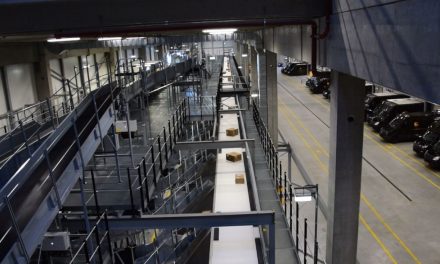
One of the more revolutionary ideas being promoted by Schiphol Group involves the construction of an underground pallet transport system named OLS, to connect the airport cargo areas with both the huge flower market at nearby Aalsmeer (which generates large volumes of inbound and outbound air cargo), and with a rail freight terminal to be built on the existing mainline near Hoofddorp. Cargo pallets and containers would be automatically loaded and guided through 5-
metre bore tunnels by magnetic levitation.
This plan has in fact been studied for the past five years, but has yet to get the goahead. However, Schiphol ‘s Hermelink argues that the concept remains valid as road traffic congestion in Europe continues to, worsen. “In future, trucks cannot be the only mode for moving cargo in and out of airports. You will need to offer an alternative in order to remain accessible for cargo,” he says.
Hermelink claims that the underground cargo transport concept is both technically feasible and economically viable. “The problem is that we still don’t have a suitable, European rail service to connect with. The overall aim is to have good hinterland connections by train, not merely a local automated transport system for pallets. We are not
going to invest $320 million in an OLS project if we don’t have the firm promise of a high-speed rail service across Europe for air cargo – and we could be waiting ten years for that!” he says.
Faced with that impasse, the airport is now exploring the idea of building a first phase underground link which simply connects the cargo sheds within Schiphol. “That will allow us to run a live test onsite and help
us to focus more attention on the need to develop rail services for cargo in Europe,” adds Hermelink. He thinks that the firstphase OLS could already save the industry some $12.5 million per year in transfer costs around the airport. A study to validate the
economics was due to be completed last month. The Dutch government is ready to
subsidise the development cost, but only on condition that private industry share some of the risk.
AIR CARGO BY RAIL
The Schiphol Group is also involved in a European Union research project named CO. ACT which seeks to “create viable concepts of combined air cargo transportation by rail”. Included in that would be a European rail network for transporting express shipments and time-critical goods. Details of a programme of developments to support that pro:
ject are due to be published later this year.
Meanwhile, construction of Schiphol’s fifth runway is well underway, with the first aircraft expected to use it in November 2002. However, it will be a further 12 months before the new 3,800-metre runway 18/36 Schiphol’s longest – is fully open for Category 3 operations. At the same time, a new highway into Amsterdam is being built to relieve the often-congested A4 which passes through the airport.
Longer term, Schiphol Group is also now considering two options for constructing a sixth runway. A report on that subject, commissioned by the Dutch Minister of Transport, is due to be completed by the end of this year. The Dutch government will then have to decide whether future development of air transport facilities in the Netherlands should be based on further expansion of Schiphol or, possibly, the construction of a totally new offshore airport. The Schiphol Group says that
the business economics of the latter option would be “difficult”.
Meanwhile, the airport is keen to stress that following several years of negative publicity about restrictions on aircraft moveents at Schiphol, it now has capacity to ccornmodate air cargo carriers which want expand their operations. Hermelink conc des that Schiphol was the last of Furope’s am air gateways to start co-ordiiiating airraft slots, some three years ago, in order to make maximum use of the capacity available. A complicated, government-imposed system f noise quotas allows 440,000 takeoffs and landings this year. Permission to increase movements by 20,000 per year has been granted for each of the years 1999-2002.
NEW ENVIRONMENTAL STANDARDS
The fifth runway could boost the ultimate total to 6oo,ooo per year, provided that the airport adheres to new environmental standards. But this is not a foregone conclusion; last year, Schiphol was fined S2.5 million by the government for exceeding the noise quotas. The airport said that the old noise quota system was not transparent, and unworkable.
Last year. supply and demand of slots was evenly balanced, arid Hermelink says that “ample” slots have been available this year. Last year, freighter flights accounted for 11,900 or just 3% of overall movements. However, all-cargo flights are a higher proportion of Schiphol’s night-time operations. In 2000, freighter aircraft accounted for
2.7% of a total 12,800 night movements. “We are not closed at night but we will not increase those flights,” comments Hermeli nk.
That approach is very much in line with Schiphol Group’s overall policy for airport development which is based on seeking a compromise between economic growth and environmental considerations. This is a necessity, in view of the great importance attached to the latter by most Dutch people and their politicians.
As far as cargo is concerned, that policy is resulting in Schiphol trying to emphasise the handling of higher-value cargo and the provision of more added-value services, rather than going for simple volume growth. The airport is now targeting four key sectors for future cargo development – high value goods like valuables and computer chips; express/mail and other time-critical goods; shipments with a short market life such as fashion items and trendy merchandise; and goods requiring value-adding activities. After negligible growth in overall volumes in 1998 and 1999, cargo was up 35% last year. However, it dropped 0.8% overall in the first half of 2001, reflecting the worldwide industrial downturn (though not too badly, compared with other European airports).
The added-value strategy for cargo reflects that of Schiphol Group for the airport as a whole. “We are not striving to be the largest airport in Europe – just the absolute best.” confirms chairman