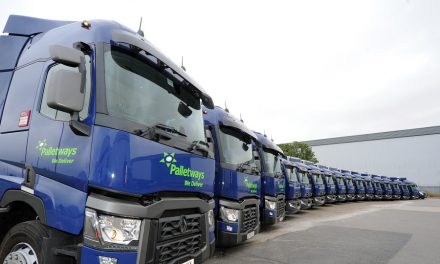




Pallet Networking
Individual haulage firms rarely have the necessary scale to saturate the UK with coverage—but pallet networks can mean fully comprehensive pick ups and deliveries, nationwide. As Steve McQueen reports, solid vehicle accountability is just one benefit to be had in this up-and-coming sector.
Once upon a time (well, 1992 to be precise) a group of like-minded operators from several regions were gathered together, bemoaning the fact that their customers were demanding more and more services for less and less money. “Well, how do the parcels people do it?” asked one. “They have a hub. Everybody trunks into the hub,” he was told. Which led to the obvious question: “Well, why can’t we do that?”
Nobody present could think of a reason why not. Feeling exactly the same next morning, they did a little market research, a bit more planning and later that year the Palletline network was born.
Ten years on there are a number of alternative pallet networks: successful examples include the Weaver Pallet Network, Pall-Ex, Palletways and The Pallet Network. Express Pallet Systems is an example of a network that failed— it collapsed early this month, owing money to creditors including some of its member companies (CM 7-13 Nov).
Pallet networks should not be confused with pallet pooling services. Networks are employed to deliver goods that are loaded onto pallets for ease of trans-shipment and delivery Pallet pools, such as those exemplified on a world-wide scale by Chep, rent out large numbers of pallets to a variety of customers. They retain ownership of the pallets but have no responsibility for the goods on them or for getting them to their destinations. Networks share the responsibility for the logistics and safe delivery of the goods on board the pallets while they are in the system.
Formal agreement
There is also an important difference between an actual pallet network and an ad hoc arrangement between hauliers to move pallets. The network usually has a formal agreement of some sort and is marketed collectively. Some networks are private companies, with haulier members; others have partners who are hauliers.
Palletline chairman Bob Russett describes the feeling among the original shareholders when Palletline went live: “We saw it as a dumping ground for the traffic we did not want to do. But within about six months, we realised that it had potential in its own right. We gave it its own image, creating the feelingofa single company”
While the customers of pallet networks benefit from better service levels and cost savings on movements of single pallets and multiple consignments, network members get more revenue through extra business. There are other operating benefits too
For example, Russett points to figures produced by the Department of Transport in its Sustainable Distribution White Paper of 1999. The DoT suggested that pallet networks were the way forward for the road transport industry. It estimated that at that time Palletline was saving over 900 vehicle movements a night by trunking to a central hub, rather than moving goods from depot to depot.
“In practice we wouldn’t have ever trunked from depot to depot, because the whole structure would have been different,” says Russett. “But even if you are as sceptical about those figures as I am, you can still understand that there is a significant reduction in costs and movements when you trunk to a central hub.”
He adds that the shareholders have an advantage in that every depot in the system is run by a specialist operator on its own patch: “Places like Aberdeen, Penzance and maybe parts of Wales might be difficult to service from a single operator, but delivery can be achieved in partnership with the local regional member.”
For example, ABE (Ledbury) covers the counties of Worcester and Hereford-shire, and parts of Wales. Transport manager Dave Ralph says that from his depot he is able to support the haulage operation by providing a variety of customers with a pallet delivery service to all points in the UK. He can do that through Palletline without dedicating a vehicle to carry out that role.
Company’s area
J&M Attwood is a member of a different network, Weaver Pallet Express. Members’ areas are allocated by post codes: “We are based in the TW postal area,” says transport manager Andy Baldwin. “We have responsibility for 1W and KT plus the top half of GU. That’s something you need to be sure about before you join—it would be no good if we had been allocated, say, Hemel Hempstead for example.”
The company signed up with Weaver Pallet Express last July because it was missing out on some revenue opportunities from nearby Heathrow Airport.
“We found we were being excluded by certain customers because we couldn’t cope with the smaller deliveries,” Baldwin explains. “A lot of shipments are one pallet to the East Midlands or one pallet to Liverpool, for example. The hauliers that could offer that service were getting the first call for business.., we wanted thatfirst call.”
Baldwin explains how some of the networks differwher you sign up: “We were originally approached by one of the other networks, It wanted money up-front for a computer system, money for this and that, plus minimum throughput, which we were not keen about. We looked at another and then finally talked to Weaver.
“To start with, we were called a partner, rather than a member or an outlet. The administration was a lot less and we don’t have to bill every other partner that we’ve used in the last month. Billing is done through Weaver.”
Operators are increasingly seeing pallet networks as more than just additional sources of revenue. For example, E Pawson Transport is a member of Pall-Ex. Transport manager Richard Pawson believes membership might help solve problems likely to emerge as a result of forthcoming legislation.
In particular, he’s thinking about problems arising with respect to certain aspects of the Working Time Directive.
Alan Cramley, director of marketing at Pall-Ex says: “We certainly think that with the WTD coming through hauliers that aren’t members of a network will struggle more than those that are. For a while now we’ve been looking at how the WTD might affect operators further away from the hub.
Staging posts
“We are looking at things like staging posts. For example, whether a member from Scotland might trunk into a members depot in Newcastle or Leeds, perhaps, before the trailer moves on to the hub from there.”
Pall-Ex currently has 48 UK member companies, and it has links with sister networks in Ireland and Scandinavia.
‘When we started at the back end of 1996 we had 29 members and moved 170 pallets on the first night,” Cramley recalls. “Now we are moving between 6,300-6,500 pallets a night.”
Next March the network will open a new hub near Junction 22 of the M1—it will be the UK’s first purpose-built pallet network hub with a 18,600m2 transshipment area, 2,800m2 of racked warehousing and• a secure lorry park with room for about 120 vehicles.
Same vehicles
In addition to the extra opportunities for revenue, Cramley reports that members benefit from increased vehicle utilisation. The obvious point is that the trunking operation takes place at night, so network members can make use of the same vehicles during the day.
The increase in efficiency can be significant—Cramley adds: “We have members that have actually reduced the size of their fleets but are now handling more freight.” And that’s one way to make any haulage tale end happily ever after.