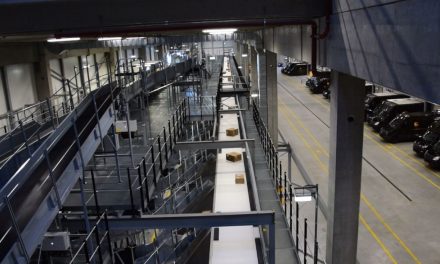




Coming up with the goods
G
ROCERYWORKS was founded by 29-year old Kelby Hagar. The seeds of his idea were sown as a law student when he was faced with an empty refrigerator and no time to go shopping. Although leaving Harvard to work for a major law firm, the idea remained.
Hagar saw the grocery business as a high-volume, but low-profit, industry. He believed that if he could eliminate the store itself, he could give the customer what they wanted at a far better profit margin. Hagar set about establishing a team to develop the concept in his spare time and by 1998, GroceryWorks.com was born. The GroceryWorks plan was to deliver groceries using the Internet as the sole order channel. The plan would work and deliver financial performance to its investors by focusing on three consumer-led concepts:
offering a full range of grocery items, which are made constantly available across dry, chilled, frozen and fresh produce categories.
ensuring that orders are delivered on time, with an unprecedented level of accuracy and no delivery charge. . time-saving, intelligent web merchandising that creates a unique customer experience that encourages repeat visits.
Hagar says, “to deliver on our three criteria we had to merchandise correctly, stock the warehouse appropriately, staff the operation, associate with the right suppliers, pick orders accurately, dynamically route our vehicles and make it all look easy when we deliver customers’ orders from day one. These were all very big challenges to GroceryWorks and will continue to be the measure of whether we succeed or not.
“The difficult aspect of an operation like GroceryWorks is trying to figure out what you’re going to run when you first start – you have no idea
if you’ll have 100 or 10,000 customers on day one. You also cannot staff to 10,000 because what happens if you don’t. We staffed to a medium range but got the 10,000. Unfortunately, for the first week, we were overwhelmed, both on the website and within the distribution centre (DC).” Hagar views GroceryWorks as a new tier, new generation, e-commerce company, “combining the high quality web merchandising aspect of the website with a back end fulfilment and distribution scenario. The overall systems have to be highly integrated and extremely solid throughout the operation. You have to have an
extremely sharp front-end web merchandising capability because that’s what consumers expect.
“Similarly,” he adds, “you have to have the best possible capability at the back end, from the warehouse management eFulfilment system, to the distribution and routeing systems. All three must tie together in a completely integrated model that allows you to do what you’re promising you’re going to be able to do. If you don’t have ‘A+ software’ at all three points you’re not going to fuffil that promise.”
Identifying the solution
GroceryWorks was certain about developing its front-end web merchandising software in-house but, looking around, the company found that some of its competitors had also taken to developing their own fulfilment systems – a complex, unproven and lengthy route that GroceryWorks was unprepared to take.
Instead, it chose EXE Technologies to provide the supply chain infostructure for the operation, selecting the firm s EXceed eFulfilment System (eFS).
Having met with EXE in June last year, system implementation began in September and was fully functional, ready for when GroceryWorks began first trading in November.
Hagar says, “by using EXE we were able to save at least 12 months’ in-house development time and an uncertain result. We felt the EXE system did more of what we wanted it to do than the others on the market. The EXceed eFulfillment System makes sense from an e-commerce perspective thanks to its virtual warehousing capability – the ability to handle inventory not necessarily within the warehouse.”
GroceryWorks’ Dallas operation is the first of
around 15 distribution centres planned by the end
By linki