

Consignia wants to increase awareness of logistics service
Consignia is on a mission to let the nation know that there’s more to it than parcels and letters. Consignia wants to grow its £750 million turnover Logistics Solutions business by increasing the awareness of its abilities to its existing customers as well as attracting new customers.
Originally set up to manage the distribution network of Consignia (formerly the Post Office, of course), the operation — headquartered at the Swindon distribution centre — can offer a full distribution network and a range of solutions. Logistics Solutions is one sixth of the Consignia empire. It operates 4000 vehicles (13 tonnes and above), 16 RDCs, 59 trains and 40 flights. The business has developed several value added services.
Business Direct is targeted at financial organisations and institutions. Consignia holds the keys to the branches and delivers internal mail prior to opening. It also collects mail, sorts it and combines it with stationery and delivers it out of hours. This is a service Consignia believes could work well for other types of customer.
Call and Collect is consolidation service typified by a service engineering operation putting parts into a tote box which is picked up by Consignia and taken to a delivery office where the service engineer can stop in and collect the parts.
Deliver and build is a service for storing mail order furniture office equipment which can be picked, packed and delivered to a customer’s premises where the item can be built. To complete the service, the rubbish is brought back for disposal.
The main focus of the Network Solutions service, where customers can pick up orders from a post office, is last mile delivery in the way a customer wishes.
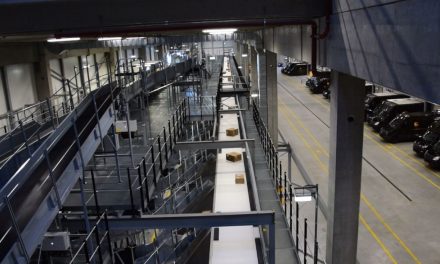
The 400,000 ft facility at Swindon, which incorporates semi-automated mechanical handling plant, is used mainly for internal supply – stationery, uniforms etc. 10,000 orders a day are shipped over a six day week, 21 hour a day operation split into three shifts.
Consignia decided that it wanted to be a player in the logistics arena about three years ago. “To do so you have to be able to manage your own logistics operation properly,” said Richard Rogers, Consignia’s head of solutions design. So Consignia set about making the required improvements to its own internal logistics. It closed 17 regional stores,
moving their operations to a single, centralised site where bulk handling continues. Consignia now supplies the end user direct and can cope with the “massive increase” in small orders. To do so it adopted automation
– a conveyor-based order picking system called Capricorn which improved, according to a customer survey, Consignia’s customer perception by 75%.
Changes were not restricted to the physical operation, Consignia also looked at the information side. It set up customer services developed primarily for enquiry management on site. To set about inventory reduction, the company purchased the Mercia inventory management package. This has had a significant impact on the business, over three years it contributed to reducing £15m of inventory to £7.2 million – an ability alongside the LIS warehouse management system.
To ensure its systems were up to external market requirements, Consignia utilised the consultancy services of Pricewaterhouse Coopers. “They (PWC) saw it as one of the biggest single changes they’d seen in logistics,” said Rogers.
As a result of these changes, Consignia Logistics Solutions’ has been a going concern since February last year. “In logistics, it takes a while to get going,” said Rogers, “We are very pleased with how it has gone.
Rogers sees the modus operandi for growth as “working with existing customers to see where we can add value, developing relationships, but not responding to tenders,” he said, adding that the company also wants to attract external customers, “We certainly want to use the capacity to the fore with external companies and look at standalone solutions.”
Consignia is bullish about its most recent service launch: Reverse Logistics. The scheme, operated in partnership with US ReTurn Logistics Ltd, is designed to help retailers and manufacturers manage the return of unwanted, unsold or damaged goods.
It is the belief of Paul Bateson, Consignia’s MD for Logistics Solutions, that this service could save companies millions of pounds. He said: “In the context of an economic slowdown and pressure to reduce costs, I expect many companies to start looking at how they can save costs in their supply chain management as currently, most businesses do not even know how much cash is tied up in returns and frequently write them off.”
When looking at its own returns Consignia realised that it had a problem shared by many companies. Part of the rationale behind selecting a US partner (ReTurn) was, according to Rogers, that country’s experience with reverse logistics; the UK has traditionally been focussed on outbound logistics. Consignia started by focussing on the entertainment sector — CDs, videos, DVDs, Computer games, etc – primarily B2B. In this sector, distributors will swamp retailers with a high profile release knowing that it is likely to be a big seller or chart topper; invariably, however, there will be a large number of returns. Returns in this sector are important commodities, not only to reclaim the item value but also, and more importantly, to work out the royalty.
Under the Consignia scheme, returns come into Swindon where they are scanned to confirm to the retailer and the manufacturer that the item has been received back. Rogers said that the advantage of scheme is Consignia’s independence, therefore avoiding disputes between retailer and manufacturer. Consignia will then also manage the final disposition route – destruction or retail,
for example.
The reverse logistics service is driven by the DART (Direct Automated Returns Tracking) IT system designed by ReTurn, which tracks and reports every detail of the reverse logistics process, from first scan to final disposition. “We can increase productivity by 30-40% by utilising DART,” claims Rogers, who adds that the other benefits of the service is increased asset recovery.
The returns management system captures information which accurately identifies appropriate debits and credits, reports replenishment inventory and production status as well as tracking product movement.
Consignia can support businesses’ own returns handling, or combine the returns process with its technologically smart warehousing, distribution and delivery systems. It is offering a range of services from managing the entire returns supply chain operation to short-term solutions to specific business challenges. Solutions can be tailored to the individual needs of each organisation and have the flexibility to meet variables such as multi-site operations, overseas links, multiple product options and changing market responses.