



A silver lining appears in the wild west
Despite a gloomy economic prognosis, one parcels company believes its niche services can see it through
Parcel activity is a good indicator of a country's economic fortunes. So if the wheels have come off the Irish economy, what does it mean for companies such as Interlink?
There are conflicting messages from CEO Brendan O'Neill. The company's traffic is up 12% this year, averaging 8,500 consignments and 16,000 parcels a night in April, but he admits that yields are under pressure. Overall, the movement of goods in and out of Ireland is static, he believes, revealing a growing disparity between gross domestic and gross national product.
"They are becoming de-coupled, " he says. "GDP is growing at 4% or 5%, but it's all in the form of transfer pricing – profits for multinationals. GNP is growing at 1% at most – and this is the real economy.
We're beginning to suffer now, and we will have embedded inflation for a year or two." Despite that gloomy prognosis, there are benefits to being one of only three or four companies offering a full national service. And the main domestic competitor – SDS, the parcels arm of the Irish post office – may lose ground under future rules on postal liberalisation, O'Neill speculates. "It will have to separate its parcel deliveries more clearly from its postal operations." Interlink has sold domestic service in Ireland since 1986, initially under the Parceline name. For many years it was typical of other operators, doing deliveries in Dublin and contracting out the rest.
There is a fear factor when UK companies are selling Ireland to shippers. "They can get it to Dublin and then they're lost, " O'Neill says.
"The lack of postcodes is a major issue and local firms are the best people to sort.
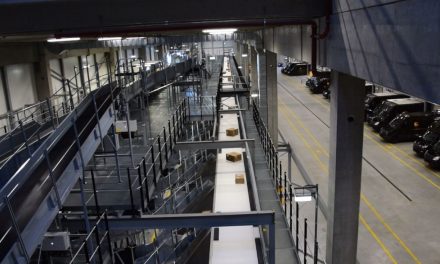
We can turn an address into a depot, " he points out – although even Interlink's knowledgeable employees have a checklist over the sorting belt at the Athlone hub to help them pinpoint the more obscure locations.
O'Neill sees customers from one or two up to 400-500 consignments a night as his core constituency. "We're built around a domestic road service which gives us the ability to pick up from scattered locations late in the day, where even where the air express people can't." Typical low-volume customers in rural west coast locations might be making candles or musical instruments. Their consignments will reach Athlone on day one and Interlink's main UK hub in Birmingham on day two, with delivery in the company's "zone 1" – Benelux, France and Germany – on day three using the DPD pan-European road service. Air freight might not be much faster for twice the price, O'Neill claims.
International shipments ex-Ireland still represent only 1% of overall traffic. "But we didn't have the (DPD) product available until a year ago, " he explains. "We're now selling Europe successfully and competing with the road services offered by TNT and UPS." Longhaul used to be subcontracted to DHL, but now goes via FedEx under the Chronopost International service, which has just been rolled out in Ireland.
By far the majority of traffic for most companies serving Ireland is inbound, and in Interlink's case the proportion is a staggering 5:1.
Recognising this reality, and the difficulties foreign shippers have in distributing there, the company is now promoting an inbound breakbulk service.
Even though customs barriers came down 10 years ago, many shippers, even in the UK, still go via a third party. So a chain might consist of a UK carrier, UK freight forwarder, maybe a second forwarder in Ireland and then a second carrier, points out chief operating officer Conor O'Neill – no relation to Brendan.
"The customer is still paying delivery charges and the forwarder 's margin. We asked ourselves how we could improve on that and, at the same time, earn something for ourselves." The new service involves Interlink collecting goods in the UK, consolidating in Coventry or Manchester to eliminate the Birmingham hub and trunking to Ireland.
"We can almost become the shipper 's Ireland office, " explains Conor.
"The trunkers are going anyway – 40ft or 45ft trailers three days a week and rigids twice – and it means we can be over in the UK selling the strength of our network.
"We're looking for those companies with agents. Ann Summers has 250 across Ireland. Kleeneze is another customer attracted by our spread of depots. A typical profile is 30 parcels a night, and we found expectations low in this market – it's not exactly 'wait 28 days for delivery' these days, but delays can occur and we have found good demand for a reliable service." A collection at up to 6pm in Manchester will be in Athlone the next night and delivered the following day if required.
One potential customer in the electronics sector wants yet faster 24-hour service.
Interlink is looking at collecting in the UK Midlands and flying direct to Ireland so that no stock has to be held locally. "Even DHL couldn't get down to Bantry Bay for 9am next day – our strength is the periphery, " says Conor.
Interlink Ireland has grown from 20 to 31 depots in the last five years. A standalone depot for the counties of Fermanagh and Tyrone, currently served by the Derry franchisee, will open later this year, while in the south, Wexford and Waterford will be split up.
Dublin and Galway, which led the 1990s boom, are now seeing lower growth, but outlying counties such as Mayo are doing well for Interlink.
In Northern Ireland, the company last year saw a 22% growth in collections, though from a relatively weak base.
But price is the issue here, says Brendan.
"North/south and UK/ Northern Ireland traffic is growing, but internal growth in the north will be poor until people learn they have to pay a meaningful price. People have under-priced themselves and service has been appalling."
Posted: 09/06/2003