


“2025 is the year of change!”
Post & Parcel speaks to Cosimo Birtolo, Head of Artificial Intelligence Hub at Poste Italiane, about why personalisation matters, the challenges of arguing with bots, and how ultimately AI can help the learning curve of the industry.
Can you tell me a bit about your background?
I began my journey with a PhD in computer science at University of Sannio, focusing on machine learning and genetic algorithms. I worked on optimisation problems, using genetic algorithms to improve fitness functions across different areas, such as user interface design, accessibility, and user experience—particularly in optimising forms.
When did you first get into robotics?
My interest began at university when I was 25 years old, and although I graduated in electronics engineering, my thesis was on neural networks.
Around 20 years ago, I worked on a real project using neural networks to predict hearing loss in newborns, based on maternal data from hospitals. The network analysed diagnostic symptoms during pregnancy to predict possible diseases in newborns. This was an amazing experience for me.
Back then, computation power was limited. We had to run simulations overnight—sometimes for days. Today, with GPUs and modern hardware, we can process these computations in real time, which has completely transformed the possibilities for machine learning and AI in production.
Can you tell me about your career at Poste Italiane?
After completing my studies, I joined Poste Italiane. I initially worked as a researcher in our R&D centre, focusing on projects co-funded by the Ministry of Innovation and European programmes. This included research in e-commerce solutions, starting as early as 2010. Over time, I moved into roles such as IT expert and IT project manager. I was involved in developing business intelligence solutions for our logistics and quality measurement departments, as well as improving service quality through data analysis.
For the past three years, I’ve returned to my AI roots. I’m now the Head of Artificial Intelligence at Poste Italiane, where I lead both internal teams and external suppliers. We focus on a wide array of AI technologies, but our three main areas are AI governance, machine learning, and generative AI.
In the last two years, generative AI has become particularly important for us. Poste Italiane is a large group with lots of different departments, including logistics, banking, energy, and telecom. This gives us an overview of our customer base, and we apply AI in everything from predictive models and customer segmentation in banking to logistics projects like route optimisation and business intelligence.
How has external interest in AI changed since you started working in the field, especially in e-commerce?
 About 15 years ago, we started working on prototypes, discovering algorithms that helped some e-commerce sites and dashboards. At that time, AI was still in the early stages. Now, those prototypes have become more of a reality.
My role has also changed a lot. I’m not just focused on creating proofs of concept anymore; I now lead innovation and bring projects into production. This shift has changed how people view AI and raised their expectations. Today, most people associate AI with generative AI, like chatbots. But in reality, generative AI is just one piece of the puzzle.
What technologies and tools does Poste Italiane use for AI projects?
Poste Italiane is flexible, using multi-cloud agreements so we can have the tools that help us build projects and solutions. At the moment, we are using a lot of Azure services, including Azure Machine Learning Studio, as well as AWS.
We are also using Databricks and data platforms, which allows us to have a complete view of our data in a catalogue segregated by user profile. This helps us build on a Delta Lake infrastructure because, in my experience, the foundation of AI models is data availability and quality. So, we start from the data and then build the solution using the best tools available on the market.
When did you first begin to see the potential for AI in the real world?
Machine learning has been in production for years. What has changed is the expectation and potential application. For example, three years ago, AI in the postal industry became a reality.
One of my favourite examples goes back to 2014: we clustered the fleet according to usage and performance. This allowed us to detect anomalies in our fleet. That was an early AI application in production—ten years ago—but now its use is massive, and nearly every project can incorporate AI in some way.
In terms of generative AI, I see 2025 as the year of change. Until now, generative AI in production was mostly limited to chatbots. Now, we are moving towards real support for users—helping them access documents and gain information. With the evolution from GPT to reasoning models, we can now build systems on top of them, making generative AI more stable.
Would you have believed 20 years ago that there would be so much investment and so many real-world applications for AI today?
No. Today, we have computational power that simply wasn’t available before. GPUs have made a huge difference. Instead of slow batch-processing methods, we can now work in real time. Machine learning solutions have enabled us to analyse data more effectively and apply these insights in live production environments.
Can you give an example of a real-world AI service you’re launching?
We’re launching a service that advises customers a few days in advance if a subscription payment—say, for Netflix—is due. The system analyses transaction patterns (with user consent) to predict upcoming expenses and assess affordability.
I was the first tester of this algorithm, and I discovered I had an Amazon Music subscription I’d forgotten about! At first, I thought the algorithm was wrong, but it turned out the system was right. My experience shows how useful the service can be.
This uses collaborative filtering and recommendation systems in a real production environment, processing transaction data every night.
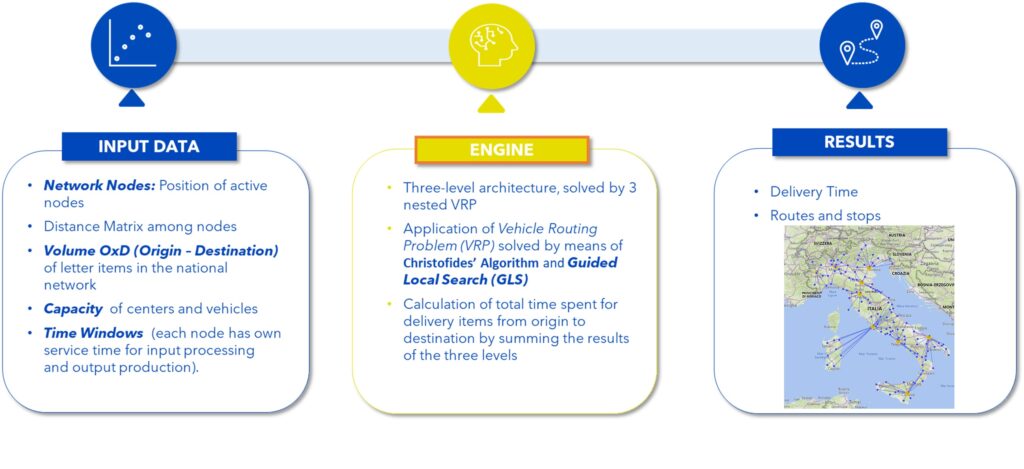
Another example of an AI system is shown in Fig. 2. It illustrates the process of retrieving delivery times per destination, as well as the number of vehicles, routes, and stops. The tool requires as input: the number of nodes in the network, a distance matrix to be solved, the volumes of collected goods to be delivered in line with a fixed service level agreement (e.g., within two days), and delivery time windows, which specify the working time per node.
Table 1. Three-layer architecture for multi-depot VRP where each first mile sorting centres collects items to send in Italy
| Routing level | Three-layer architecture | Node | Example |
| Depot | Start | Sorting Centre at Origin | Milan |
| First mile | First layer | Sorting Centre at Destination | Florence |
| Intermediate Node | Second Layer | Transshipment Node | Lucca |
| Middle-mile end point | Third Layer | Delivery Centre | Viareggio |
The Simulator Engine works step by step to plan deliveries. First, it breaks the problem into three layers. At the top layer, it figures out how vehicles should leave the depot, where they go first, and when they will arrive. Next, it connects those first stops to the second set of stops, checking arrival times again. Finally, it assigns the last set of stops to the second layer and calculates the complete delivery routes.
By running this process, the system helps logistics planners understand how changes in the number of goods or the size of vehicles affect delivery times. This is especially useful when designing same-day delivery services. In the model, distances between stops are measured in terms of travel time, using a table that reflects the average driving time between any two points.
Fig. 1 Simulating routes and expected delivery times at destination
Is public concern around AI slowing down adoption, particularly in logistics?
No, I think logistics now has a real opportunity to adopt and benefit from AI.
For example, in last-mile delivery, a postman’s local knowledge is critical. When a postman is relocated, performance can drop because that knowledge is lost. AI can help new employees learn this knowledge quickly—what used to take years to acquire. AI supports the learning curve, both in logistics and in many other sectors.
What about the ethics of using AI?
We’ve published an ethics manifesto. AI is not replacing people; it’s augmenting their work, reducing gaps between junior and senior employees, and shortening the time required to learn new tasks.
For example, with the Polis project, customers can now apply for passports in most Italian post offices. Staff can either read the documentation or use an AI assistant to guide them through the process for the first time.
How is Poste Italiane planning to use AI in its operations?
We’ve invested heavily in AI. For example in middle-mile optimisation AI helps optimise route planning, reducing costs from under-loaded trucks and avoiding last-minute rearrangements during peak periods. Also it can help with predictions – AI can forecast seasonal and unexpected spikes, allowing better planning of fleets and resources during periods when the volumes go crazy like peak. Additionally Generative AI will help employees and customers access complex documentation quickly and accurately. We also use AI for simulations, such as what happens if a logistics hub fails or if we add a new node.
Are there unique challenges in Italy that AI can help address?
Yes. Most Italians interact with Poste Italiane, which gives us an opportunity to personalise services. Our app is a single point of contact where customers can manage banking, utilities, insurance, and more.
Our challenge is to personalise offers—to recommend the right product to the right customer at the right time. AI plays a key role here.
What are the current limitations of using AI in logistics?
The first limitation is expectations. People often think AI “knows everything”, which leads to misunderstandings. Results must always be validated, and sources should be traceable.
Bias is another challenge. For example, even in route planning—like when people argue with Google Maps—there’s resistance. Similarly, when using AI in logistics, people need to understand the correlation between input and output. Education is key.
What excites you about the potential of AI for Poste Italiane?
AI can help us provide better services for all users and employees. Poste Italiane has undergone a huge digital transformation in the past six years, and AI is a big part of that journey.
However, AI is not “just a tool”. It requires governance and literacy. We need to educate people about safe AI usage, avoid risks like sending sensitive documents to public AI platforms, and ensure models are unbiased.
Governance is essential to control quality and manage bias. For example, even a simple survey can introduce bias based on where and how the data is collected. Our goal is to build models that are efficient, transparent, and fair.
Ultimately, AI supports people—it enhances their work rather than replacing it.
Biography
 Cosimo Birtolo earned his degree in Electronic Engineering from Politecnico di Bari in 2006 and a Ph.D. in Computer Science from the University of Sannio in 2012. At Poste Italiane, he leads multidisciplinary teams developing AI systems for postal, insurance, and banking sectors, with a focus on forecasting, customer behavior analysis and LLM applications for information retrieval. His AI research has generated over 30 publications on clustering, optimization, and machine learning applications in postal sector. From 2015 to 2022, he chaired the UPU Standards Board and .POST Group, representing Italy in global postal organizations including UPU, PostEurop, CEN, and IPC.