


Austrian Post: The mobility transition does not stop at the city limits.
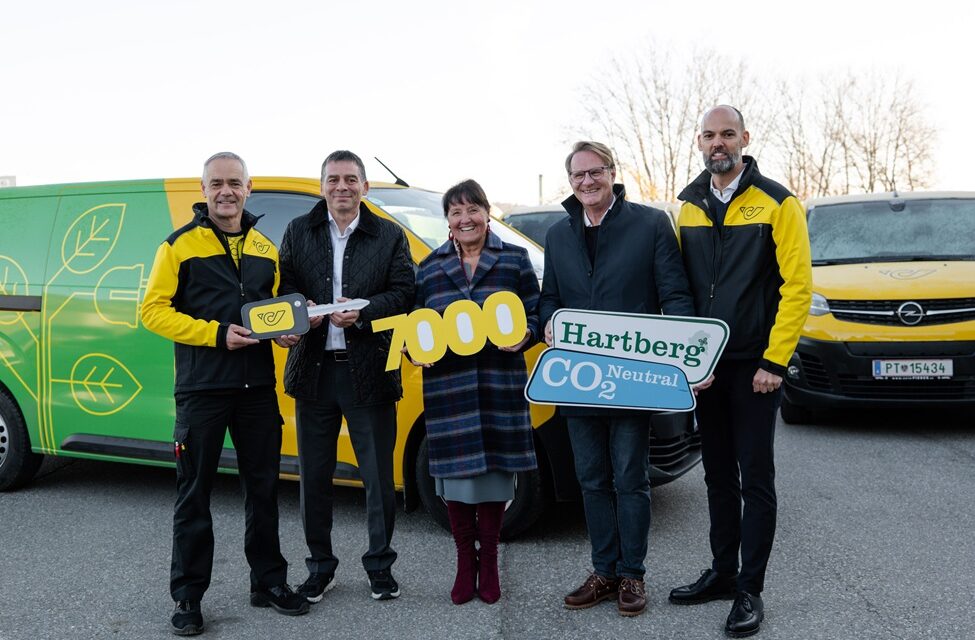
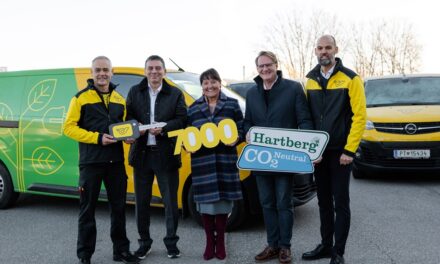
Austrian Post has now put its 7,000th electric vehicle into operation at the delivery base in Hartberg (Styria). The new Fiat E-Scudo will be used for deliveries in Hartberg and the surrounding municipalities in the future.
With this milestone, the Post shows that e-mobility has long been part of everyday delivery for them not only in metropolitan areas but also in rural areas. By 2030, all of the approximately 9,500 delivery vehicles will have been converted to electric drive.
The ceremonial commissioning of the 7,000th electric vehicle took place together with Manuela Khom, Deputy Governor of Styria, Marcus Martschitsch, Mayor of the City of Hartberg, and Peter Umundum, Deputy General Director and Board Member for Parcel & Logistics at Österreichische Post AG.
Manuela Khom, Deputy Governor of Styria: “The mobility transition does not stop at the city limits. Climate-friendly mobility solutions must also work in rural areas and prove themselves in everyday life. The fact that the 7,000th electric vehicle of the Austrian Post is now being deployed in Hartberg shows that this development has long since reached our regions as well. Such investments combine climate protection with innovation and show that Styria is also at the forefront of future mobility.”
Marcus Martschitsch, Mayor of the City of Hartberg: “We are very pleased and proud that Austria’s 7,000th electric vehicle from the Post is being deployed here in Hartberg. The Post’s investment in modern, CO2-free delivery is a strong signal for our region. Hartberg is now delivered entirely with electric vehicles; this is lived climate protection and a great asset for the quality of life in our city.”
Peter Umundum, Deputy CEO, Board Member for Parcel & Logistics, Austrian Post AG: “7,000 electric vehicles is a strong announcement and shows that our CO2-free last-mile delivery has long since arrived throughout Austria. Our electric vehicles prove themselves in the city just as well as in rural areas. The 7,000th will soon depart from Hartberg, clearly demonstrating that e-mobility also works reliably in rural areas.”
The 7,000th electric vehicle of the Post is a new Fiat E-Scudo. The electric panel van is equipped with a 75 kWh battery and has a range of up to 350 kilometers according to WLTP (Worldwide Harmonized Light-Duty Vehicles Test Procedure). The cargo area has a cargo volume of 6.6 cubic meters. The Post trim also features air conditioning, heated seats, a heated steering wheel, a rearview camera with parking sensors, and enhanced LED lighting in the cargo area.
Österreichische Post not only acquires around 1,000 additional electric vehicles per year but also continuously invests in intelligent charging solutions and the expansion of its photovoltaic capacities.
In addition to charging at logistics centers or delivery bases, around 660 couriers now use the option to drive home with their electric vehicle after the end of the service and charge it overnight. The post provides them with a corresponding charging cable that records the charging processes and transmits them to the company for billing. The charged electricity is automatically reimbursed at the next payroll. The prerequisite for this is an electricity tariff that guarantees renewable energies from Austria.
The majority of the e-fleet continues to be charged via the Post’s charging infrastructure. At around 200 locations, including delivery bases and logistics centers, a total of 4,800 charging points are in operation. Since this year, an innovative battery storage system called the eHub has also been used as an energy buffer, enabling electric vehicle charging even at locations with limited grid capacity. The charging infrastructure is now complemented by nearly 40 locations across Austria with photovoltaic systems, which together reach a capacity of around 20 megawatts peak (MWp). The share of self-supply with electricity from Post’s photovoltaic systems thus amounts to about 20 percent on the balance sheet. Electricity is purchased exclusively from Austrian renewable energy sources.
In a pilot project, the Post is also testing bidirectional charging (Vehicle-to-Grid, V2G). In this process, electric vehicles can not only be charged but also temporarily store electricity and feed it back into the grid.