


Tag: UPS

How technology delivers for UPS

Not so long ago, UPS drivers worked off maps, 3-x-5 note cards, and their own memory to figure out the best way to run their routes. That changed in 2005 when UPS began to implement a USD600 million route optimization system that each evening maps out the next day’s schedule for the majority of its 56,000 drivers. So sophisticated is the software that it designs each route to minimize the number of left turns, thus reducing the time and gas that drivers waste idling at stoplights.

UPSs innovation is an example of how technology can help companies capture institutional knowledge about their customers. Before, when a truck loader or driver walked out the door, the package- loading techniques or route tips they’d developed over the years usually walked out with them. Now that knowledge is accessible in a central system. That eases the burden on substitute drivers and shortens the training time for new ones, lessening the chances of a lapse in customer service. In November alone the company’s drivers logged 3 million fewer miles than they did the year before.

Read More

China Southern freighter expansion to lift Baiyun airport Move will force Hong Kong to rethink air cargo policy as dominance comes under threat, say analysts

China Southern Airlines, the biggest mainland airline by fleet size, plans to grow its freighter fleet to 14 aircraft from two by 2011.

Analysts say the move will mean more freight connections and volume for Guangzhou’s Baiyun International Airport, forcing Hong Kong to rethink its air cargo policy.

Like its mainland rivals, China Southern has been slow to develop its freighter business because of a long-standing imbalance between exports and imports.

Load factors for inbound cargo traditionally have been much lower than for outbound, keeping profit margins thin.

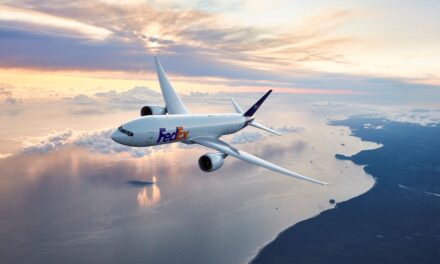
China’s airlines operate only 33 freighters with 7,700 tonnes of capacity. UPS and FedEx, the two biggest dedicated cargo carriers in the United States, between them operate 1,000 freighters.

However, China’s swift economic growth, spurring demand for such prime air freight commodities as high fashion, fine wines and delicate electronic products, means that imports and exports are coming into a better balance.

Chinese airlines have begun forming cargo alliances with international carriers.

Shenzhen Airlines teamed up with Lufthansa to form Shenzhen-based Jade Cargo Airlines which operates two Boeing 747s and plans to expand the fleet to six aircraft by next January.

China Southern has a code-sharing arrangement with Air France Cargo-KLM Cargo.

By 2011, China Southern expects to take delivery of six Boeing 777s, which can stay in the air for 10 hours and six Airbus A300s which can be adapted for passenger and freight service. The first of the A300s, which are principally designed for use on regional routes, will be delivered at the end of this year.

Mr Dodwell said the Hong Kong government needed to update the import-export ordinance to facilitate more transshipment business.

And he said the efficient use of air space was being hindered by the conservative air spacing regime in Hong Kong and the refusal by the Beijing government to allow planes bound for or leaving in Hong Kong to fly through the mainland’s air space below 10,000 feet.

“I can see healthy growth of 5 per cent to 8 per cent a year in Hong Kong for the next five years,” said Matthew Ma, vice-president of Cargolux, an airline based in Luxembourg. “It is a performance-based industry; it’s not only capacity that counts.”

Mr Ma said Guangzhou could not match Hong Kong for reliability and just-in-time management. However, Hong Kong still needed to embrace the “open skies” concept and address the issue of high service charges, he said.

Read More

UPS, Airbus Revise A380 Agreement

UPS and Airbus signed an agreement yesterday that sets out a timetable for deciding the status of UPS’s order for the freighter version of the A380. The agreement specifies changed delivery dates for the A380F and provides for possible termination of the original purchase agreement by either party later in 2007.

Deliveries of UPS’s first 10 A380s were originally scheduled to begin in 2009 and run through 2012.

“UPS’s decision to purchase the A380 freighter was based on a lengthy evaluation of our future network needs to meet customer demands across a variety of global trade lanes,” said Bob Lekites, UPS’s vice president of Airline and International Operations. “Those needs still exist and UPS has been carefully evaluating various options since Airbus announced production delays late last year. This agreement will provide us additional time to evaluate our network requirements and make a decision once and for all as to how best to ensure service to our customers.”

Read More

UPS, Airbus Revise A380 Agreement

UPS and Airbus signed an agreement yesterday that sets out a timetable for deciding the status of UPS’s order for the freighter version of the A380. The agreement specifies changed delivery dates for the A380F and provides for possible termination of the original purchase agreement by either party later in 2007.
Deliveries of UPS’s first 10 A380s were originally scheduled to begin in 2009 and run through 2012.
“UPS’s decision to purchase the A380 freighter was based on a lengthy evaluation of our future network needs to meet customer demands across a variety of global trade lanes,” said Bob Lekites, UPS’s vice president of Airline and International Operations. “Those needs still exist and UPS has been carefully evaluating various options since Airbus announced production delays late last year. This agreement will provide us additional time to evaluate our network requirements and make a decision once and for all as to how best to ensure service to our customers.”

Read More

European ''emerging markets'' come into focus

Against the background of moderate growth and increasing consolidation in mature Western European markets such as Germany, Britain and France, “emerging markets” such as Spain, Poland, Russia and Turkey are increasingly coming into focus for international express and parcel operators. In contrast to the moderate single-digit growth rates in core European markets, the continent’s smaller markets are growing at high single-digit or double-digit rates and offer attractive areas for expansion. More acquisitions can be expected in these markets during 2007.

Germany, France and Britain jointly account for over half of the total European express and parcel market, according to CEP-Research data. The “Big Three” are the home markets or major regions for carriers such as DHL, TNT, GeoPost/DPD, GLS and UPS. But the market growth rates have slowed significantly in recent years, mostly due to low economic growth, and operational costs are rising. The inevitable result is tougher competition between the market leaders and a clear trend towards market consolidation.

Read More

Advertisement

Advertisement

Advertisement

P&P Poll

Loading

Have you noticed a decrease of non-EU inbound parcel volumes since the implementation of the new €3 charge?

Thank you for voting
You have already voted on this poll!
Please select an option!


Post & Parcel Magazine


Post & Parcel Magazine is our print publication, released 3 times a year. Packed with original content and thought-provoking features, Post & Parcel Magazine is a must-read for those who want the inside track on the industry.


Pin It on Pinterest