



Commitment to speed
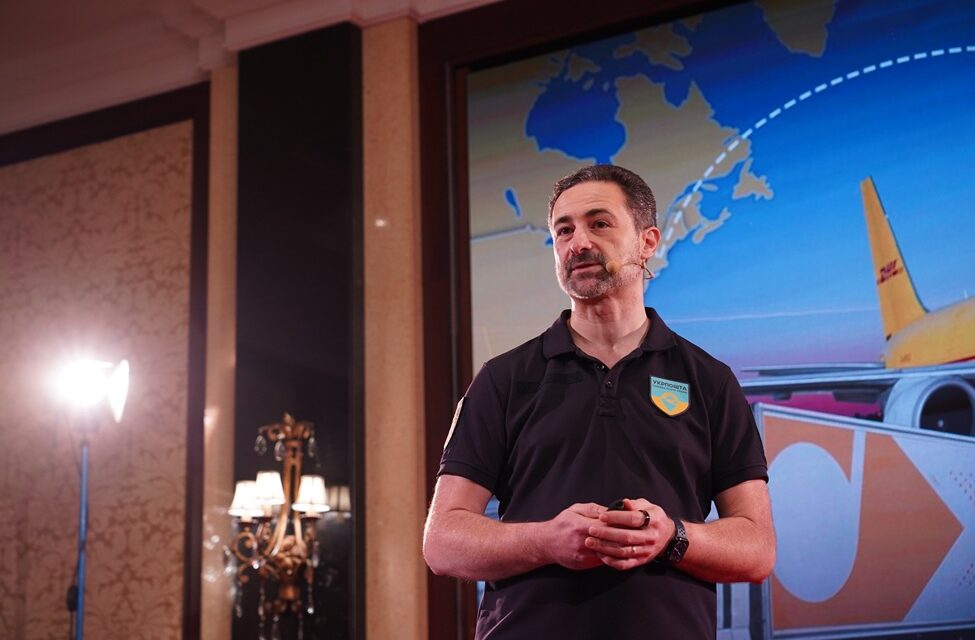
Aliona Korop, Head of Communications at Ukrposhta, explains how Ukraine’s national postal operator has carried out its largest transformation during the war. She also speaks to Ukrposhta CEO Igor Smelyansky about how the company has never wavered from its aim of finding the fastest route for goods to reach their destination, even when operating in an unstable political and physical landscape shaped by war.
“A fullscale war could have put on hold Ukrposhta’s biggest digital and infrastructure transformation. Instead, during wartime the company completed 100% automation of its key logistics network: 24 automated hubs capable of processing up to 3 million items per day.
Ukrposhta invested UAH 687 million of its own funds, without loan financing.
More important than the result itself were the conditions under which it was achieved. Ukrposhta was building a new logistics system at the same time as it was losing post offices, vehicles, and sorting facilities to Russian attacks. This experience reshaped the company’s very understanding of resilience: the system must be ready to operate even when the original plan no longer works.
Building while Russia destroys
 Since the start of the fullscale invasion, Ukrposhta’s cumulative losses have exceeded USD 70 million (≈ UAH 3.1 billion). The company has lost access to more than 1,500 post offices, many of which remain under occupation. Around 650 facilities have been damaged, and more than 40 completely destroyed. These figures continue to grow due to daily Russian attacks.
The enemy has destroyed over 430 company vehicles. Sorting centres and post offices came under fire; Ukrposhta employees have been injured, and some have been killed while performing their daily work.
Even under such conditions, the company not only maintained national connectivity but continued to rebuild and scale its logistics.
“The hardest management decision was not about choosing equipment or the order of hub automation. The main question was different: do we have the right to invest in the future when tomorrow is unknown? In the end, we have changed focus. Not ‘what will happen in a year?’ — because no one knows — but ‘what must Ukrposhta be able to do in a year under any scenario?’ The answer was speed, automation, reserve capacity, and the ability to instantly reconfigure logistics,” said Ukrposhta CEO Igor Smelyansky.
From manual sorting to three million items
Ten years ago, much of Ukrposhta’s letters, parcels, and press were sorted manually, computers were present in only about 20% of post offices, and the average vehicle age was 18 years.
Today:
• 100% automated sorting of parcels, letters, periodicals, and medicines.
• All post offices are computerized.
• Average fleet age has reduced to 6 years.
• Every item is tracked 24/7.
• Ontime delivery is consistently at 95–98%.
Letter processing performance at a single logistics site has nearly tripled: from about 600 to 1,600 items per hour. Sorting press across 990 routes now requires only 50 m² instead of 150, and the number of workshops for newspapers and magazines has been reduced from 24 to 5.
Part of the created capacity is deliberately kept in reserve. In wartime this is not surplus, but a guarantee of continuity: if one hub is damaged, routes and flows are instantly redirected to another.
“When part of the logistics chain stops after shelling, within a couple of hours we are already working on a new route. War leaves no time for reflection: you either adapt instantly or stop. We choose adaptation,” Igor Smelyansky explained.
Ukrainian made equipment
All sorting equipment for Ukrposhta was designed and manufactured by the Ukrainian company Ukrainian Intelligent Systems (UIS).
Abroad, Ukrainian technological capacity is most often associated with IT, digital government services, and, after 2022, defense tech. Ukrposhta’s automation shows another side of this story — engineering and industrial.
Ukrainian companies are capable of designing and producing complex equipment for one of the country’s largest logistics networks, scaling it, and supporting system operations during war.
How Ukrposhta operates today
 In wartime conditions, Ukrposhta delivers 95–98% of items on time, meeting international quality standards. Increasingly, parcels between Ukrainian cities arrive the next day. Full tracking in the Ukrposhta 2.0 app and on the postal operator’s website allows customers to follow their parcel’s journey, while the automated network enables faster redistribution of flows.
The scale of international logistics has also changed. Ukrainian civilian airports have been closed since the start of the fullscale invasion, yet Ukrposhta maintains postal exchange with 230 countries and territories worldwide. Delivery times have improved dramatically: to the USA in 8–12 days instead of the former 3–4 weeks, to China in 8–12 days instead of about six weeks, and to Australia in 12–14 days.
Ukrposhta’s share of the Ukrainian international delivery market has exceeded 50%, and its international service ranks among the best of postal operators globally.
What to expect next
Ukrposhta endured one of the harshest winters in 2025, with temperatures dropping below –20°C and heating and electricity unavailable. Yet operations continued: working on generators, reverting to manual processes when necessary, and maintaining service. The next winter will be even harder, as the enemy seeks to destroy the entire energy infrastructure, just as it targets logistics centres.
But Ukrposhta will not retreat. Post offices are being equipped with diesel heaters, stoves are installed in villages, and processes are redesigned so operators can work offline if mobile or internet stations are destroyed: loading data onto devices, working autonomously, then synchronizing later.
Vehicles and sorting centres are being destroyed, but adaptation continues. Cars are dispersed so a single drone cannot destroy many at once. As a backup for large sorting centres, which may become enemy targets for reasons of economic efficiency, a network of smaller reserve hubs is being built. Their cost is lower than the missiles used to attack them. In some cases, even inflatable rubber warehouses are considered, which can be deployed in 3–4 days.
The adaptation process never stops, because only an adaptive company and country can prevail in modern war.
Automation that people can feel
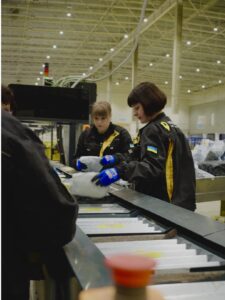 Technological modernisation has value only if felt by the customer waiting for a parcel, not just the engineer at a sorting line.
Ukrposhta has enabled card payments in 100% of the settlements in its network. Even within 10 km of the frontline, where no other service operates, mobile post offices continue delivering medicines, pensions, social payments, food, parcels, and correspondence. At the same time, the company is expanding parcel locker networks, introducing quickpickup cells in post offices, and through the updated mobile app allows customers to fully manage shipments online.
Automated logistics has also enabled rapid scaling of new critical services. For example, orders under the Ukrposhta Pharmacy project pass through a single automated sorting system and reach even the most remote and frontline communities.
In this case, technology reduces not only processing time but also the distance between people and essential needs.
The result is on the scoreboard
Valeriy Lobanovskyi, a famous football coach, used to say: “You can say whatever you want, but the result is on the scoreboard.”
In the first half of 2026, Ukrposhta recorded a pretax profit of UAH 122 million. Parcel volumes increased by 12–17% yearonyear, depending on the segment. The company achieved this result against the backdrop of wartime losses.
This balance perhaps best explains the logic of transformation: investing in the future and surviving today’s crisis are not necessarily contradictory. Sometimes the first is a condition for the second.
Unlike many postal operators worldwide, Ukrposhta (even during war and despite significant losses) receives no aid from the government and can rely only on its own resources. Moreover, the company recognises its responsibility, knowing that the taxes it pays go directly to funding Ukraine’s Defense Forces.
Not optimising only for good times
Pandemics, energy crises, geopolitical conflicts, and wars have shown how vulnerable systems can be when optimised for a single predictable scenario.
For decades, businesses learned to eliminate everything “unnecessary”. This increased efficiency. At the same time, recent crises revealed the cost of systems with no margin for error.
In 2022, Ukrposhta could have halted modernisation and waited for stability. The problem with that decision became clear later: no one could say when stability would return.
Thus, one of the most important management lessons for Ukrainian business during the years of fullscale war may not be about predicting the future.
“My main lesson from this war: the most valuable thing is your team. You cannot run a company from your desk. I personally visit our frontline post offices, because in extreme conditions a decision made ‘from above’ without understanding the reality on the ground can cost employees their lives. You need to see with your own eyes the people, the post offices, and the conditions they work in.
The second lesson: you cannot build a business assuming everything around will always work according to plan. Ten years of fundamental transformations at Ukrposhta during my leadership essentially prepared us for the hardest test, though we didn’t know it at the time. When the fullscale war began, the system did not collapse: we were able to quickly reroute, change processes, and continue working across the country. The future cannot be guessed. The leader’s task is to build a company ready to act when any plan stops working,” concludes Ukrposhta CEO Igor Smelyansky.”