



Celebrating 250 Years of Delivering

The Postal Service was founded on July 26, 1775. As the nation grew bigger, the mail made it smaller, offering a way for people from Colonial-era cities in the Northeast to reach the limits of a frontier that was racing westward from the Appalachian Mountains to the Mississippi River, to the Golden Gate of California, up to the gold fields of Alaska, and across to the tropical shores of Hawaii.
 In 2025 USPS celebrated its 250th year with a number of events, special stamp releases plus the publication of a book “Delivering for America: How the United States Postal Service Built a Nation” written by James H. Bruns, a former director of the National Postal Museum. Post & Parcel spoke to U.S. Postal Service Licensing and Creative Manager Amity Kirby to find out more about the integral role of USPS in American history and how the new book brings that history to life.
What was the aim of writing the book?
This book reflects the first time that the USPS is telling its own history from the beginning to its anniversary year of 2025. It is an objective retelling of how the Postal Service evolved out of the British post to an organisation that delivers to every home and business six to seven days a week.
The book’s subtitle says the USPS “built a nation.” What does that mean?
The Post Office Act of 1792 gave Congress the power to “Establish Post Offices and post Roads” and in turn made the Post Office the only government agency required to build roads since its mission was to travel from place to place to deliver mail. The geography and topography of the new American colonies made mail delivery almost impossible. Roads that had been initially carved out through dense forest and over mountain ranges, left behind tree stumps, potholes and stones that impeded travel by post riders and postal carriages. Bridges needed to be built to ford rivers instead of waiting on ferries. To adhere to its mission the Post Office would build paths and roads in order to get the mail from one place to another. By 1789 there were more than 1,075 miles of postal roads; one year later there was almost 1,800 miles. It wasn’t until 1811 that the federal government approved funds to build a National Road, about 620 miles long, to connect Maryland and Illinois, while the post office? had ploughed over 36,000 miles of post roads.
Did anything surprise you about USPS during your research and the writing process?
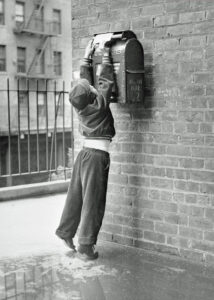 In broad brush strokes, most people know about the modern history of the USPS since many others have written about this, but they don’t understand the vital role that the Postal Service has been in building America, assisting through crises and wars, and serving communities. Some examples: after 1775, how were Post Office locations decided upon. One just had to send a letter to their Congressperson; it would be brought up and voted on; everyone knows about the Pony Express which followed a westerly trek, but what about the Eastern Pony Express; the first air mail wasn’t in an airplane but in a balloon; besides mail and children, what else has been sent through the mail: a woman once sent her entire household through the mail and even a brick bank was mailed to its new location; there was a fast train called the “gold (or silk) train” that whisked money from California banks to New York; the influenza of 1918 had letter carriers wearing masks when delivering mail; the phrase “Public Enemy No. 1” was first coined after a train was robbed and one of the robbers was given the monicker. These are but a few stories included in the history of the Postal Service.
USPS has always evolved — from horses to rail, air, and now electric vehicles. Which technological leap most transformed how mail moved?
Rail, air, and auto each had its own impact on how mail was moved from place to place. The invention of the Steam Engine and Railroads probably had the most impact since the railroads were built before roads were even paved. Railway cars were refitted so that Postal employees could sort mail while the train was running. When mail bags were ready for the next town, trains only had to slow down to transfer mail bags to and from a post that could hold the bag. Even though trains were important, they were built to reach the most populated areas. So, the Postal Service still needed the other forms of transportation to get the mail from the train into cities, towns and rural areas. Even today, it takes trucks, cars, sometimes planes, sometimes donkeys, and even bikes, and of course by foot to get a letter to a house mailbox.
In the book it says that the mail helped Americans “understand themselves and each other.” How did the postal system shape public connection or identity?
Freedom of the Press, particularly through newspapers, and the Post Office have had a symbiosis relationship since the colonial era. Early American leaders underscored the importance of that relationship; for example, Benjamin Franklin stated that “free and unfettered communication is inseparable from liberty”, a sentiment echoed by George Washington regarding broad public discourse. Pro-American viewpoints in newspapers likely aided the war effort by boosting Army morale and disseminating crucial information about events during the war. Newspapers and the Post Office effectively functioned as the government’s channel of communication.
With the signing of the Postal Act of 1792, newspapers reprinted the Act in whole and thereby notifying citizens of Congress’s authority over the Post Office and the making of postal roads. Significant government actions became headline news, such as the federal government moving from New York to Philadelphia, then to D.C.. The almost 200 newspapers in print at the turn of the 19th century ensured widespread access to the same information, regardless of geographical distance.
How has USPS maintained trust and reliability over the years?
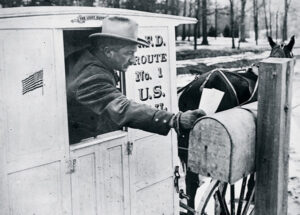 Americans and the Postal Service are inextricably linked and have been for more than 250 years. The sole purpose of the USPS from its beginning is to serve the American public by delivering mail. The USPS was part of the Civil Defence initiative during the 1950s and 60s, outfitting mail delivery vehicles into ambulances; it was serving across the country, delivering food and medicine along with other federal emergency response teams during the weather outbreaks in 2010 and 2011; the recent devastation in 2024 from Hurricane Helene, mail carriers reported to work the next day even when some of their own homes had been destroyed. The Postal Service is often a familiarity for customers bringing a sense of connection and normalcy back.
After 250 years, what do you envision as the next significant reinvention for the USPS?
The United States Postal Service is an essential institution that deserves preservation. With roots that extend beyond the creation of the Constitution and the nation itself, the Postal Service has always been a catalyst for innovation and excellence. Our role in advancing transportation methods, such as rail and air, has been pivotal.
For the past 250 years, we have faithfully served this country, and it’s crucial that we establish a sustainable foundation for the next 250 years. Our operational scope is as remarkable as our legacy; we connect 170 million addresses across the nation, creating an astonishing 28.9 quadrillion connections—more than the number of stars in a galaxy or known galaxies.
Additionally, we maintain more retail locations than the combined total of the five largest and most recognisable global brands. We are on the front lines in the wake of natural disasters, underscoring our vital role in the nation’s infrastructure.
Our service is characterised by uniform pricing, unmatched speed, and reliability. The ability to send a letter from San Juan, Puerto Rico, to Fairbanks, Alaska—a distance of approximately 3,900 miles—for just 78 cents is truly remarkable.