


Priceless shipping: managing fragile, large, unusual and valuable items
Phil Rivers, Franchisee Training and Support Manager at PACK & SEND, discusses what is required to ship fragile, large, unusual and valuable items safely in an increasingly complex logistics environment.
In most areas of the post and parcel sector, efficiency is driven by standardisation. Automated hubs, uniform packaging profiles and streamlined routing have enabled impressive gains in speed and cost control.
But, when it comes to the real world, not every shipment fits into a standardised box – metaphorically or literally.
At PACK & SEND, we refer to our specialism as FLUV items – fragile, large, unusual and valuable. These consignments range from fine art and antiques to musical instruments, specialist sports equipment, IT infrastructure, medical and laboratory equipment, furniture and high-value electronics.
What they share is not a particular sector, but a significantly higher risk of damage if they were to be treated generically when shipped.
Understanding the risk profile
Fragility can be obvious, as with ceramics or glazed artwork, but it can also be less visible. Servers and switches, for example, may appear structurally robust, yet remain highly sensitive to vibration and impact. Antique furniture may tolerate weight but suffer surface abrasion or joint stress if improperly secured.
Large or unusual dimensions or weight may introduce handling challenges at multiple transit points.
Value adds another layer of consideration. High declared worth increases the importance of correct documentation, insurance alignment and careful carrier selection.
In practice, many shipments combine several of these factors. A framed painting may involve glazing, delicate finishes and international documentation. A motorbike may require crating, palletisation and regulatory compliance for cross-border movement.
Precision in packaging
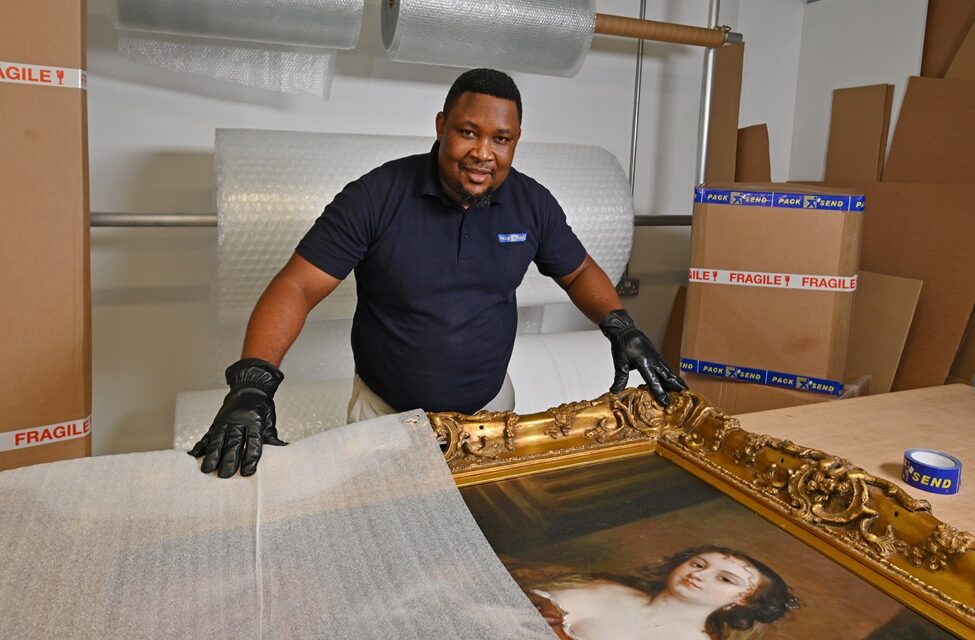
For fragile items, protection begins with preventing direct contact between the packaging and the vulnerable surface. Acid-free materials, protective tissue and raised borders may be required for artwork or delicate finishes. Where glazing is involved, stabilisation techniques help reduce movement in the event of breakage without leaving residue on presentation surfaces.
Certain surface finishes, such as polished wood or gilding, should not come into direct contact with bubble wrap. Instead, layered systems combining soft barriers and sealed air cushioning can distribute impact away from the object itself.
Larger consignments require structural consideration. Double or triple-walled cartons may be appropriate for mid-weight items, but heavier or high-value shipments often call for custom-built wooden crates. These crates must be constructed to suit the dimensions and weight of the item, with internal foam density calibrated accordingly. For international shipments, materials must comply with ISPM15 regulations.
Oversized items such as furniture, motorbikes or large-format equipment may require palletisation, integrated lifting points or A-frame supports to maintain stability throughout transit. The objective is not simply to enclose the item, but to control movement and reduce stress across each stage of handling.
Documentation and transit management
Physical protection alone is not sufficient for complex consignments. International shipments of art, antiques or specialist equipment frequently require detailed commercial invoices, accurate commodity codes and, where applicable, carnets or export registrations. Electronics containing lithium batteries require additional declarations. Errors at this stage can lead to delays, and delays increase the number of handling points.
Increased handling correlates directly with increased exposure to damage. For SMEs trading internationally, this can be a particular challenge. A gallery sending work to an overseas exhibition, a laboratory exporting equipment for research collaboration or a technology firm relocating servers all face documentation requirements that extend beyond basic courier forms.
Specialist support in aligning paperwork with packaging and carrier selection reduces that risk.
A growing category
The diversity of goods sold online has expanded significantly in recent years. Fine art, collectible antiques, bespoke furniture and specialist equipment are now routinely bought and sold across borders. As a result, the volume of non-standard shipments moving through parcel networks is increasing.
For the post and parcel sector, this presents both operational challenges and opportunities. Standardised networks remain essential for high-volume ecommerce. However, there is also growing demand for services capable of managing exceptions such as consignments that do not conform to uniform parcel profiles.
Service centre models, like PACK & SEND, which have local assessment capability can be particularly effective in this area. The ability to inspect, measure and evaluate an item physically before dispatch allows for tailored packaging decisions. When combined with established international carrier relationships, this approach provides both flexibility and reach.
Trust and accountability
For many senders, the value of a shipment is not limited to its financial worth. Artworks, heirlooms, specialist instruments and bespoke equipment often carry reputational or emotional significance.
Clear communication about packaging methods, transit stages and documentation requirements builds confidence before dispatch. Ongoing visibility during transit reinforces that trust.
In an environment where much of logistics is increasingly automated, there remains a role for hands-on assessment and informed guidance. Fragile, large, unusual and valuable consignments highlight that need clearly.
They require technical knowledge, regulatory awareness and appropriate materials. They also require judgement and an understanding of when standard solutions are sufficient and when a more engineered approach is necessary.
As the range of goods moving through parcel networks continues to expand, the ability to manage non-standard shipments reliably will become increasingly important.
For more information, go to www.packsend.co.uk.