



Solving Addressing from Space
Post & Parcel speaks to George Tabakyan, Director of OnyX Space, about the growing need for accurate addressing and how a space technology company is entering the postal and logistics sector to solve real-world delivery challenges.
What is Addressa?
Addressa is a next-generation digital addressing system built using satellite data to improve delivery efficiency.
What problem is Addressa designed to solve?
Around 50% of people in the world do not have a proper address. If we remove the UK, Europe, and some parts of the US, much of the rest of the world does not have proper addressing.
Population is increasing, new urban areas are appearing, and it is difficult to keep up with that expansion by assigning traditional addresses. In the past, addresses were mainly used by the post office for letters and mail. Today, delivery companies, third-party logistics providers, utility companies and many other services rely on addresses.
How did you come up with the idea?
 I travel a lot to many countries where there are addressing problems.
People may have long addresses with street names, building numbers and other details, but the delivery driver still has to arrive in the area and call for directions.
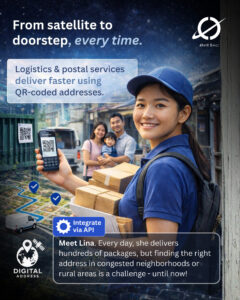
This creates a major challenge in last-mile delivery. Today we have excellent e-commerce platforms and sophisticated delivery systems, but the final stage of delivery still depends on a person getting the parcel from the last distribution point to the customer.
You can send a package from the UK to India, and it will arrive in the correct city. The challenge is often the last mile. That is where delays, losses, driver frustration and inefficiencies happen.
How does Addressa work?
Addressa solves a range of addressing problems by offering a globally unique digital address.
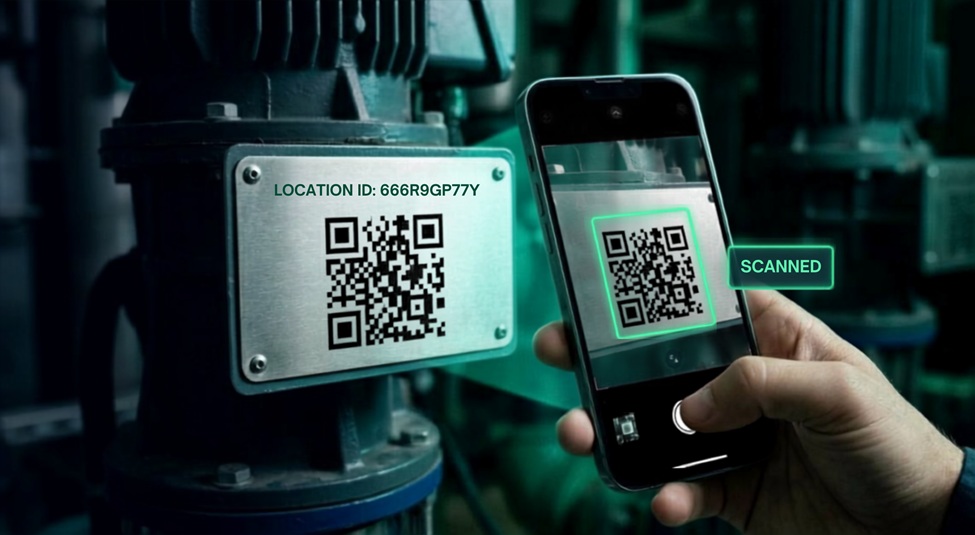
Instead of using a long address with a postal code, city and country, customers receive a digital address that can be accessed via a QR code that links to the exact location of their entrance, not just the building.
For example, if someone lives in a rural area and the entrance is 50 meters away from the house, the digital address identifies that entrance. If it is a large apartment building with multiple entrances, the system identifies the correct entrance, so the driver does not have to search for it.
How accurate is Addressa?
We have assigned a digital address to 3m x 3m square in the world, so practically any location on the globe has a unique digital address and related QR code.
The accuracy is generally within two to three metres which is sufficient for delivery purposes.
What is your background?
My background is in satellite imagery. I am the Director of OnyX Space, a space company specialising in satellite data and creating geospatial solutions based on satellite data. Those solutions can be for agriculture, urban planning, weather monitoring, flood and disaster monitoring, and finally, digital addressing. Addressa is one of these solutions.
How did your experience with satellite imagery shape the development of Addressa?
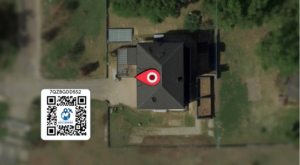 When using conventional maps, you often cannot identify the entrance to a building or the access point to a property. You might see the road and the plot, but you may not know how to access the property.
The idea is to provide a fixed address that allows the driver to navigate directly to the entrance.
The last-mile driver is often the lowest-paid person in the delivery chain, but that person is the backbone of digital e-commerce, and I believe that they will remain essential for the foreseeable future.
With our system, the driver does not need to know the local language or ask for directions. They simply scan the QR code and go directly to the location.
Many location systems already exist. Why would a postal operator choose Addressa instead?
Our system is universal. A person simply has their name and QR code. No additional address information is required.
This also helps address privacy concerns because people do not need to have their full address details displayed on packages traveling long distances.
We learned a lot from existing systems, so we built a new system that is highly efficient, quick to implement, cost-effective, and most importantly user-friendly.
How would the system work for deliveries?
Delivery companies and postal operators would integrate the system. The cost will be covered by the postal service or the delivery company.
When a customer places an order on any online platform that is integrated with Addressa, they would select their exact location on a map. A 10-digit code and QR code would then be generated and sent along with the order.
The delivery company receives the QR code. Drivers can scan the codes for all their parcels, and our system provides the most efficient delivery route to each front door.
The parcel can also be tracked, and customers can see when the driver is approaching.
What would a postal operator need to do to implement Addressa?
Addressa will be integrated with the addressing system that the postal service has; hence all users can access the system and get their digital addresses/QR codes.
What makes the system globally scalable?
We do not build separate systems for individual countries. We have one system for the entire planet.
Whether it is a city, a country, a rural area, an urban area or even an island in the middle of the ocean, every location can have its own unique QR code.
What are the biggest challenges to adoption?
The main challenge for adoption is for decision makers of a postal agency or a delivery company to understand the advantages of integrating Addressa into their system. To address this, we are open to launching pilot projects with any interested organisation.
What is your long-term vision for Addressa?
Our primary goal is to solve a major last-mile delivery problem.
Of course, as a business we need to make money, so we want the system to be adopted in as many countries as possible, especially developing countries where addressing systems are unclear.
We want delivery systems to become more efficient, parcels to arrive faster, and privacy concerns to be reduced.
The system is also scalable for future drone delivery because it provides a precise location for where a drone should land.
Are you targeting drone delivery companies as well as postal operators?
Not yet. Drone delivery is still being tested and remains limited by regulations in many countries and cities.
We do not see widespread adoption in the immediate future, but where drone delivery becomes viable, our system is already prepared for it.
How is your system different from other digital addressing systems?
Some countries have their own digital addressing systems, but those systems are country-specific and the same numbering system can potentially be repeated elsewhere.
Our advantage is that we look at the world as a whole. Every location has a digital address/QR code that is globally unique.
What stage is the product at today?
The software platform was finalised in April 2026 and is currently being evaluated by three potential customers: two in Southeast Asia and one in Central Asia.
What message would you like to share with the postal and parcel industry?
We come from a space background and look at problems from a different perspective.
When agricultural companies look at crops, they look horizontally. We look vertically from space.
We understand the global addressing problem, and we believe we have a very good and very affordable solution. Addressa is open for any type of collaboration, including implementing pilot projects to show the system efficiency and advantages.
 For more information, vist: https://addressa.io/
George will be exhibiting at WMX Asia in Hong Kong, 15 – 17 September 2026 – visit him to find out more about Addressa.